
Importing prefabricated container houses from China involves choosing the building system, agreeing on the specification, arranging transport and customs clearance, and preparing the destination site. For a bulk order, several of these jobs need to run alongside production.
The process becomes easier when the factory, freight forwarder and site team work from the same information. Drawings guide production, packing lists identify what has been shipped, and installation instructions tell the receiving team how those parts fit together.
1. Give the Factory a Useful Project Brief
Your first request for quotation (RFQ) should explain the intended use, quantity, destination, preferred dimensions, internal configuration and planned opening or move-in date. Include a sketch or floor plan if you have one.
You can also start with a description of how the space will be used. For accommodation, specify the number of people per room and whether bathrooms will be private or shared. For an office, explain how many workstations, meeting rooms and other spaces you need. The factory can then propose a building type and layout, develop the drawings, and work through the materials and fittings with you.
Tell the supplier what installation support is available at the destination. An order arriving as components requires a different site plan from one arriving as assembled or folded units. Local labour and lifting equipment should be considered when choosing the delivery format.
Product choice also has a substantial effect on cost. A capsule house can add unnecessary expense to a basic worker camp, while a bare-bones detachable unit may fall short of the finish expected at a resort. Compare container house structures against the standard of accommodation you want to provide.
2. Compare Quotations for the Same Scope
Each quotation should identify the floor plan and specification it covers. Ask for a breakdown of the steel frame, wall and roof materials, insulation, doors, windows, flooring, electrical fittings, plumbing and bathroom fixtures. Furniture, appliances, packaging and spare parts should also be listed as included or optional.
This makes price differences easier to explain. One supplier may include a finished bathroom and internal wiring; another may be quoting an empty shell. Comparing the final figures without checking those items can lead to choosing a different product from the one you intended to buy.
Specify the agreed trade term, named place or port, and version of the rules. EXW, FOB, CIF and DDP allocate different costs, risks and responsibilities between buyer and seller. ICC’s Incoterms 2020 guidance explains the purpose and scope of these rules.
Build the project budget around what the quotation actually includes. A price that includes sea freight does not automatically cover foundations, installation or external utility connections.
| Budget item | What to check |
|---|---|
| Houses and accessories | Building system, specification, packaging, furniture and spare parts |
| Export and sea freight | Inland transport in China, export clearance, sea freight and insurance |
| Destination logistics | Port charges, customs clearance, duties and taxes, inland delivery and storage |
| Site work | Foundations, unloading, assembly or unfolding, utility connections and finishing |
| Delivery support | Drawings, installation instructions, inspection records, training and after-sales arrangements |
Use this breakdown to identify costs outside the supplier’s quotation and avoid counting included items twice. The contract should also state the payment schedule and what must be completed before the production lead time begins.
3. Confirm Local Requirements and Utility Connections Before Production
Send the factory the requirements for the project location before materials and equipment are ordered. These may affect the structure, electrical components, plumbing fixtures and documents supplied with the houses.
Turn those requirements into specific items the factory can check: component specifications, required supporting documents, connection details and any inspection records needed by the project team. Agree which equipment will be supplied by the factory and which will be purchased locally.
For water and drainage, confirm pipe sizes, connection types, outlet positions and heights. For electricity, confirm the supply requirements, incoming connection point and positions of equipment. These details need to match the plans used by the installers at the destination.
The amount of internal plumbing and electrical work completed in the factory depends on the product and configuration. Identify the remaining site work in the quotation so the receiving team knows what it needs to connect and check.
4. Approve One Set of Documents for Production
Before production starts, the quotation, floor plan, material list and connection drawings should refer to the same approved design. Give revisions a date or version number so everyone can identify the current documents.
For example, moving a bathroom can change partitions, drainage positions and electrical points. If a change affects only part of a bulk order, identify the relevant units. Confirm its effect on price and completion date before the factory implements it.
For repeated units, agree when the buyer will inspect or approve the first completed example. A separate sample unit is not necessary for every order, but checking the first unit can help resolve a layout or finish issue before it is repeated across the batch.
Some checks need to happen earlier. Photographs of the frame, insulation and concealed pipework are most useful before those areas are covered. Agree which records you need while the factory can still produce them.
If you appoint an independent inspector, provide the approved drawings, specification and inspection scope. The inspection report should show whether the goods match the order.
5. Prepare Shipping Documents and Installation Information Together
Plan freight around the agreed factory completion date. Keep shipping, clearance, inland delivery and installation as separate stages in the schedule, each with its own responsible party and expected timing.
Before shipment, check the commercial invoice, packing list and applicable transport document, such as the bill of lading or sea waybill. Ask the customs broker to confirm any additional documents required for the particular goods and destination.
The goods description should identify what is being imported: prefabricated building units, building kits or separately supplied components. A description consisting only of “containers” can leave the receiving parties unclear about the cargo.
For multi-container orders, connect package numbers to the packing list and installation drawings. The site team should know which container holds each batch, where the fittings are packed, and whether a complete set of parts will arrive together.
Send package dimensions, weights and unloading information to the receiving team before dispatch. This gives them time to arrange suitable equipment and identify any missing information.
For Australian shipments, check the applicable BICON import conditions before shipping. The houses and packing materials must meet the relevant conditions, the container must be free of biosecurity contamination, and the required documentation must accompany the goods. Australia’s Department of Agriculture explains these arrival requirements.
6. Prepare the Site While Production Is Underway
Once the foundation and installation plans are confirmed, site preparation can progress alongside manufacturing. Check the foundations and support locations against those plans, and arrange external water, drainage and power connections.
The receiving team also needs a vehicle access route, unloading position, working area and a place to store materials. Use the actual packing and installation information when arranging these spaces.
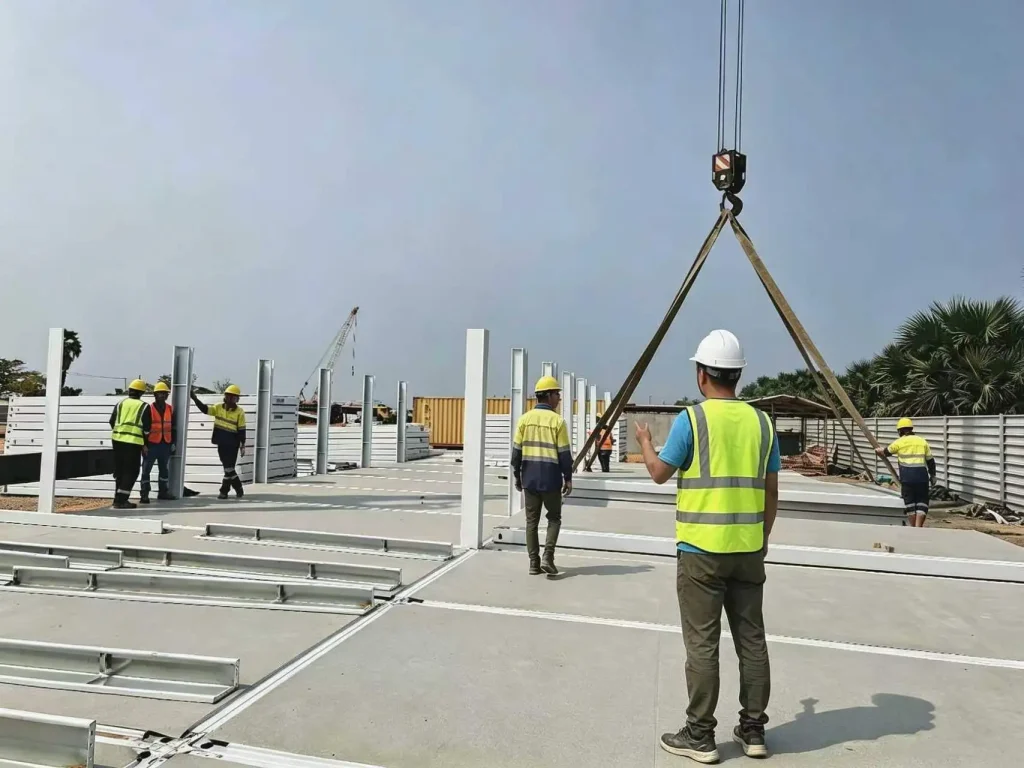
Detachable and flat pack systems need room to organise components and assemble units. Foldable and expandable products need the working clearance and supports shown in their installation instructions. The chosen structure determines how the crew should prepare.
Keep panels, fittings and equipment protected after unpacking, with labels retained until installation is complete. Small parts should stay with their numbered packages or units so crews can find them when needed.
For phased projects, coordinate delivery batches with the installation sequence. Receiving a complete batch for the first building area is more useful than receiving scattered parts for the whole site.
7. Record Arrival Condition and Complete the Handover
Check the packaging and goods as they arrive. Record any visible damage with photographs and the corresponding package or unit number, then notify the relevant parties under the agreed delivery and claims arrangements.
During installation, keep a list of missing, damaged or unfinished items and record how each is resolved. Before handover, check doors, windows, fittings, utility connections and equipment operation with the installation team. Factory inspection records form part of the documentation; the completed installation also needs to be checked.
Agree after-sales responsibilities when signing the order, including the warranty period, when it starts, covered parts, and who pays for replacement freight or local repair labour. Keep equipment model numbers, installation instructions and spare-parts records with the project files.
To begin a quotation with ReachTop, send us your intended use, quantity, destination and any available layout. We can use that brief to recommend a building system and prepare the drawings and configuration for your order.