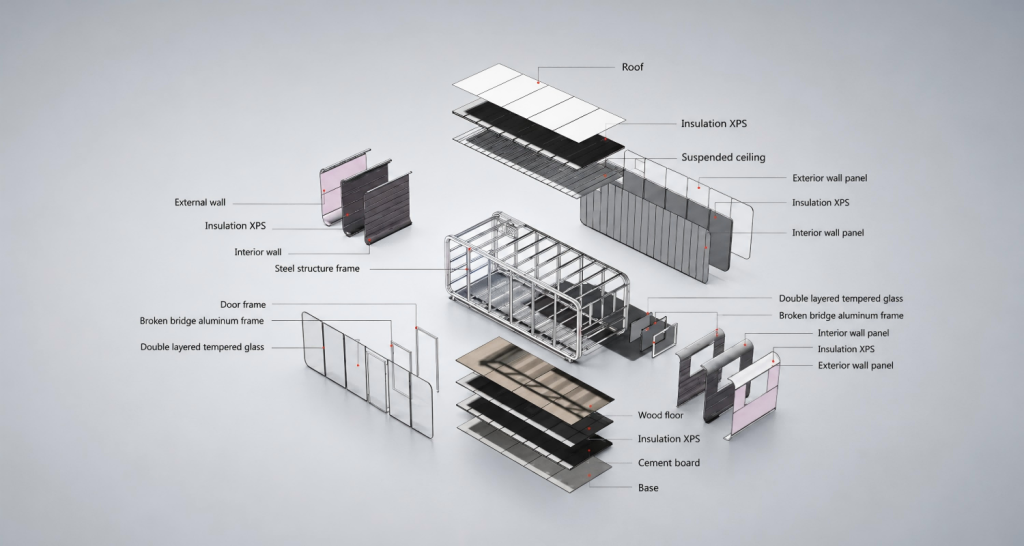

Container houses manufactured in China are also described as prefabricated, modular or portable buildings. This article covers purpose-built houses made with steel frames and building panels, including detachable, flat-pack, foldable and expandable systems. These are distinct from houses converted from used shipping containers.
Two houses can look almost identical while using different steel sections and surface treatments. Steel grade, member thickness, galvanising and the final coating each contribute to the finished building. Understanding these four elements helps explain differences that are difficult to see in a product photograph.
Why Is Q235B Steel Commonly Used?
Q235B is a common structural steel grade in Chinese prefabricated container houses. Its established supply, ease of fabrication and welding, and cost make it a practical choice for frames, beams, columns and other steel components.
In the designation Q235B, “Q” refers to yield strength, “235” identifies the minimum yield strength within the applicable thickness range, and “B” identifies the quality grade. Under GB/T 700, the relevant steel products with a thickness of up to 16 mm have a minimum yield strength of 235 MPa and a tensile strength of 370–500 MPa. Different thickness ranges have different requirements. These values appear in Table 2 of GB/T 700.
Yield strength describes the stress level at which steel begins to undergo permanent deformation. Tensile strength is the maximum stress reached during a tensile test. Both describe the material itself; the load capacity of a complete house also depends on how its structure is designed and assembled.
How Does Q235B Compare with Japanese, American and Australian Steel Grades?
Steel grade names differ between countries. A useful comparison needs to account for the product form and thickness, as well as the strength values.
The following table uses 6 mm hot-rolled material as a common reference. This thickness is a comparison basis, not a recommended thickness for every house component.
| Steel grade | Standard or reference basis | Minimum yield strength | Tensile strength |
|---|---|---|---|
| Q235B — China | GB/T 700 | 235 MPa | 370–500 MPa |
| Q355B — China | GB/T 1591, hot-rolled delivery condition | 355 MPa | 470–630 MPa |
| SS400 — Japan | JIS G 3101 | 245 MPa | 400–510 MPa |
| A36 — United States | ASTM A36; cited data use US customary units | 36 ksi, approximately 248 MPa | 58–80 ksi, approximately 400–552 MPa |
| Grade 250 plate — Australia | AS/NZS 3678 | 280 MPa for 5 < t ≤ 8 mm | At least 410 MPa |
These are requirements from the cited standards or manufacturer data, rather than test results for a particular batch. The A36 row retains the original US customary values; MPa values are approximate conversions. Finished hollow sections have their own applicable product standards.
Q235B shares a broadly comparable strength range with several structural steels used overseas, although the values are not identical. Australian Grade 250 plate, for example, has a minimum yield strength of 280 MPa at this reference thickness. The number in a grade name does not tell the whole story.
Similar strength values also do not establish full equivalence. Chemical composition, weldability, impact requirements and material certification affect whether one grade can replace another. A strength comparison table alone does not demonstrate compliance with a different national standard.
Is Q235B Suitable for Houses? When Does Q355 Make Sense?
Q235B can be used for structural building components. The performance of the finished house depends on the beam and column sections, steel thickness, spans, bracing, welds and connection details. Two frames made from Q235B can therefore have different load capacities.
The thickness relevant to structural design is the base metal thickness. Zinc and paint add to the measured overall thickness, but they should not be counted as structural steel. BlueScope’s technical guidance makes this distinction between base metal thickness and total coated thickness.
Q355 offers higher yield strength. At the reference thickness used above, 355 MPa is approximately 51% higher than 235 MPa. This is a difference in a material property: it does not automatically increase a complete house’s load capacity by 51%, or justify reducing member thickness by the same proportion.
For larger spans, particular loading conditions or projects with a specified material requirement, structural design may identify a benefit from using Q355 in selected components. The additional cost depends on the sections, quantities and order specification; there is no universal percentage increase for an entire house.
For many standard projects, suitable member sizes, thicknesses and connections are the foundation of a sound steel frame. A higher steel grade can support a particular design, while corrosion protection remains a separate requirement.
Steel Grade and Galvanising Are Separate Specifications
Steel sheet or tubing may arrive at the house factory already galvanised. However, the designation Q235B does not mean that the steel has a zinc coating. The same grade can be supplied bare or with different surface treatments.
Different components within one house may also follow different galvanising processes. Two common hot-dip routes are:
Galvanising after fabrication. The steel component is fabricated, prepared and immersed in molten zinc to form its protective coating.
Fabricating from pre-galvanised sheet or strip. The material is galvanised on a continuous line before it is bent, formed or made into tubing. Subsequent cutting and welding require additional treatment at the affected areas.
Both routes can involve hot-dip galvanising. A thick main beam and a thin square tube do not, by themselves, indicate that one is hot-dip galvanised and the other is “cold galvanised”. Thin-walled tubing can also be made from continuously hot-dip galvanised strip.
The expression “cold galvanising” can be ambiguous. It may refer to electroplating, or it may describe zinc-rich paint. An electroplated metallic zinc layer and an applied zinc-rich coating are different treatments, as explained in the Hot Dip Galvanizers Association Southern Africa’s technical guidance.
What Do Zinc Coating Numbers Mean?
Zinc coating specifications may be expressed as mass per unit area, in g/m², or as thickness, in micrometres (µm). These are different measurements.
For continuously galvanised sheet, Z275 identifies a coating mass designation of 275 g/m² across both surfaces combined. Assuming pure zinc and an even split between the two faces, this corresponds to approximately 19–20 µm per side. It does not mean 275 µm on each face. BlueScope’s coating guidance explains these coating designations and thickness relationships.
Hot-dip galvanising of fabricated components is specified differently. The examples below show how to interpret the figures.
| Process or material | Example specification | Meaning |
|---|---|---|
| Continuously galvanised sheet or strip | Z275 | 275 g/m² across both surfaces combined; approximately 19–20 µm per side if evenly distributed |
| Steel component hot-dip galvanised after fabrication | 2 mm steel thickness | Under the general ISO 1461 requirements: minimum mean coating thickness of 55 µm and minimum local thickness of 45 µm |
| Steel component hot-dip galvanised after fabrication | 4 mm steel thickness | Under the general ISO 1461 requirements: minimum mean coating thickness of 70 µm and minimum local thickness of 55 µm |
The final two rows illustrate general requirements for non-centrifuged steel articles; the standard includes provisions for particular material conditions. These are reference examples, not universal coating specifications for every ReachTop model. See the ISO 1461:2022 revision notes and coating table.
This explains why two frames described simply as “galvanised steel” can have different zinc coating specifications. The process, coating quantity and treatment after fabrication all contribute to the actual protective system.
Welds and Cut Edges Need Protection Too
Cutting pre-galvanised steel exposes the steel at the cut edge, while welding can damage the existing zinc coating nearby. These areas need cleaning and appropriate corrosion-protection repair as part of the subsequent finishing process. The HDGASA inspection and repair guide describes the treatment of damaged galvanised coatings.
This work often becomes hidden once wall panels and finishes are installed. Weld areas, underframe corners and connections are therefore meaningful parts of factory quality control, even when they are less visible than the finished exterior.
What Does Powder Coating Add to the Finish?
The term “baked paint” is frequently used to describe a house’s metal finish. It identifies a curing process without identifying the coating chemistry.
Liquid paint and powder coating are different application forms. Polyurethane, polyester and epoxy refer to resin systems. A coating cannot be identified as polyurethane simply because it has been cured in an oven.
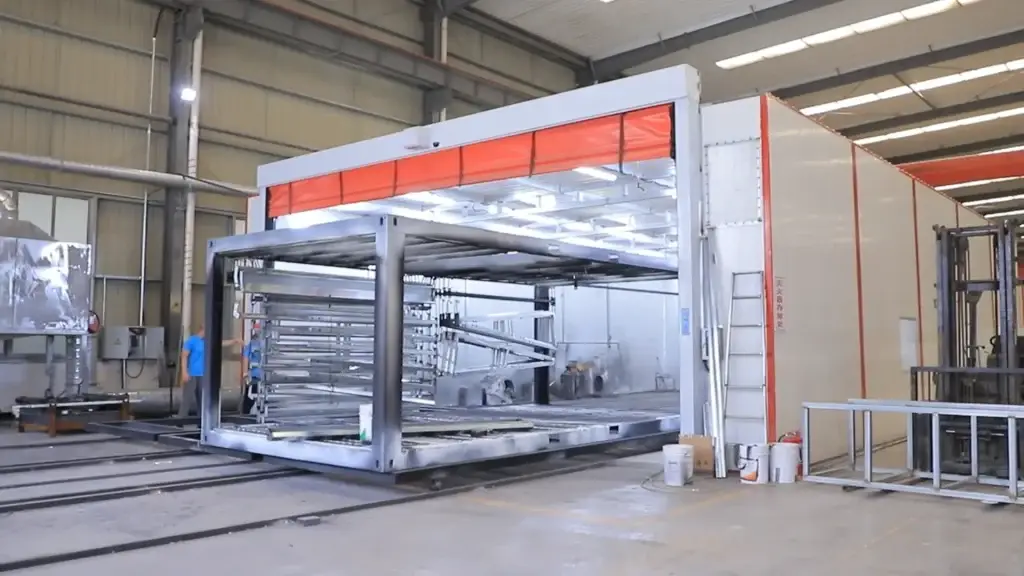
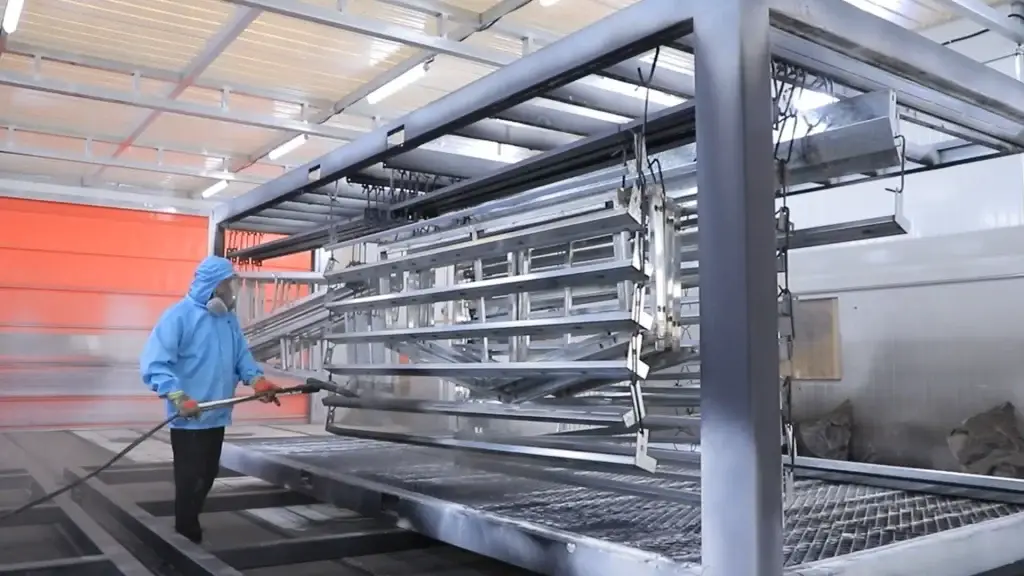
Powder coating involves applying dry powder to the prepared metal and then curing it in an oven. Different formulations can produce smooth, matt, fine-textured and other surface effects. Joseph Ash’s process overview describes how powder application and curing form the finished coating.
ReachTop offers an oven-cured, fine-textured matt powder finish. Its lower gloss and consistent texture give exposed framing a more refined appearance, making the finish a visible part of the house’s overall design.
Long-term coating performance also depends on how the factory carries out the process:
Surface preparation: removing grease and contamination, treating weld areas and using preparation suited to the substrate.
Coating selection: choosing a system intended for the exposure conditions of the component.
Film application and curing: controlling film thickness, workpiece temperature and curing time according to the coating’s technical requirements.
Final inspection: checking adhesion, coverage and edges, and repairing damage caused by handling.
Powder coatings are formulated for different environments. For example, AkzoNobel’s Interpon 700 epoxy-polyester powder is not recommended for outdoor use. This illustrates why the specific formulation matters alongside the application method.
A well-run coating process carries out each stage consistently. If grease, corrosion or weld contamination remains beneath a finish, a newly painted frame may still look attractive, with problems only becoming apparent during transport or outdoor exposure. Liquid paint can also provide an effective protective system when correctly selected and applied; the use of a spray gun alone says little about the final quality.
Fluoropolymer Finishes on Capsule House Aluminium Panels
A capsule house’s steel frame and aluminium exterior panels are separate components with different functions.
The steel frame carries structural loads and relies on suitable member design and corrosion protection. The aluminium panels create the exterior form, while their coating contributes to weather resistance, colour retention, gloss and appearance.
The fluoropolymer finish discussed here is applied to the capsule house’s aluminium exterior panels. It should not be confused with the protective coating on the steel frame. A single house can use both systems, each serving its own part of the construction.
FEVE and PVDF are different fluoropolymer resin systems. Their formulations and application or curing processes can differ, so the two names should not be used interchangeably. AGC’s technical resources explain the distinction between these coating technologies.
For capsule houses used in hospitality or commercial projects, the aluminium finish contributes to the exterior appearance, while the steel frame provides the structural support beneath it. Together, the frame, corrosion protection and panel finish form the complete construction system.