
When buying a modular container house from China, buyers often focus first on price, appearance, and shipping. But for a project intended for long-term residential, rental, or commercial use, another question needs to be answered early: once the house arrives, how will it meet local building requirements, be installed, and receive the necessary approvals for use?
A practical approach is:
The Chinese factory handles material procurement, agreed prefabrication work, and shipping planning. A local professional team handles on-site construction and coordinates design, approvals, and inspections.
This is a realistic compromise. It retains the advantages of Chinese sourcing and factory production while bringing people familiar with local requirements into the project.
Why Can’t You Rely Entirely on the Chinese Factory?
Building requirements vary by location. The same modular house may need design changes when its destination or intended use changes.
Structural loads, wind and earthquake resistance, fire safety, insulation, weatherproofing, electrical work, and plumbing all need to be assessed against the project’s local requirements. Land-use permission, foundation design, and utility connections also cannot be resolved through a factory’s standard product drawings alone.
Many buyers are unfamiliar with these processes, and Chinese factories may not fully understand the destination’s requirements either. This creates a gap in expectations: the buyer assumes that a product available for export can be used locally, while the factory considers its work complete once production meets the order specifications.
Factory completion, import clearance, and approval to occupy a building are separate stages.
For example, the Australian Building Codes Board explains that building materials and products require evidence of suitability, while projects are also subject to relevant state or territory legislation. The documentation supplied by a factory needs to support the compliance assessment for the actual project.
Even a Chinese factory with experience in the destination market still needs local professionals to address site-specific design, construction, and approval requirements. Our container house compliance page explains the manufacturer’s role and the scope of supporting documentation.
What Should the Chinese Factory and Local Team Each Handle?
The division of responsibilities should be agreed before production begins.
| Work Area | Chinese Factory | Local Professional Team |
|---|---|---|
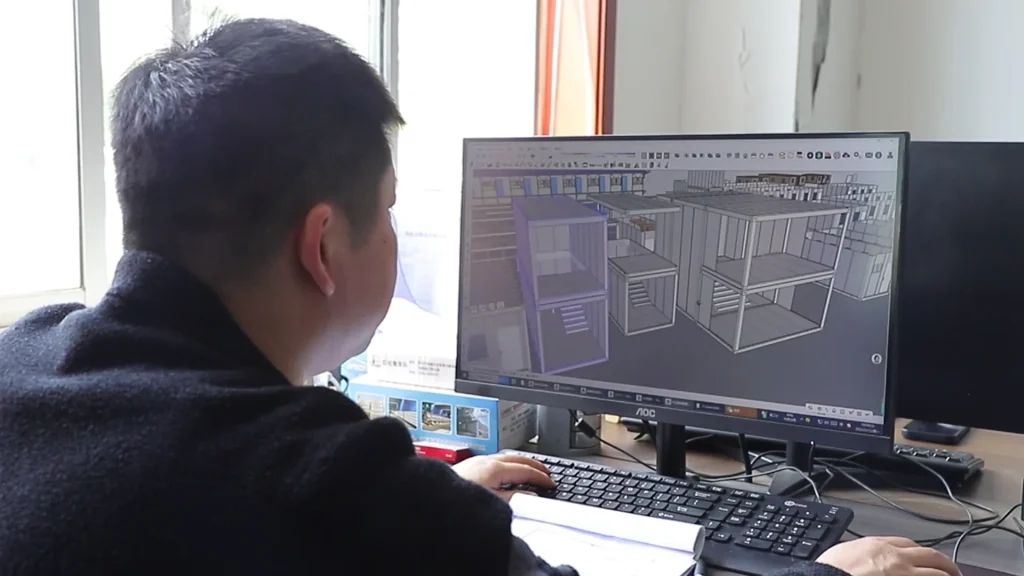
| Design coordination | Provide product drawings, construction details, and manufacturing proposals; make agreed revisions | Have the relevant designers and engineers review local requirements, site conditions, and design parameters |
| Material procurement | Purchase materials to the agreed specifications and provide product documentation, test reports, and traceability records | Check whether materials and supporting documents are suitable for the project; identify items better sourced locally |
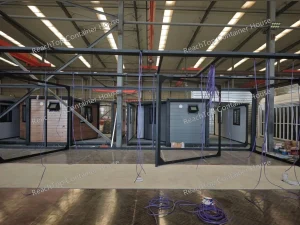
| Factory prefabrication | Complete agreed steel fabrication, panel cutting, component preassembly, and identification | Confirm connection details, dimensional tolerances, and the on-site assembly sequence in advance |
| Shipping arrangements | Plan packaging, container loading, and transport protection; provide packing lists | Check site access, unloading, lifting, and storage conditions |
| On-site construction | Provide installation instructions and agreed technical support | Complete foundations, assembly, connections, weatherproofing, and specialist trade work |
| Compliance and inspections | Supply manufacturing quality records and additional technical information as agreed | Coordinate permits, inspections, and completion procedures, with qualified professionals and authorities performing their respective roles |
The local contractor needs relevant experience, but the ability to assemble modular houses does not mean they can independently handle every compliance requirement. The project may also need structural engineers, building designers, electricians, plumbers, and other appropriately qualified professionals.
Which Work Makes Sense to Complete in China?
A Chinese factory’s main contribution is in sourcing, fabrication, and repeatable prefabrication work.
Where materials meet the same technical requirements and their supporting documentation is acceptable for the project, purchasing certain materials and components in China may offer a price advantage. Steel fabrication, cutting panels to size, and preassembling standard components can also reduce the amount of repetitive work required on site.
However, the level of prefabrication needs to suit the local construction process.
If concealed work requires inspection, or certain connections must be completed locally, the parties should agree in advance which areas can be closed up and which must remain accessible. Finishing more work before shipment is of little benefit if those areas later have to be opened for inspection.
Transport also requires a separate comparison. Flat-packed or panelized components may improve container loading efficiency but require more on-site assembly. Fully assembled modules can reduce some site work, yet may face restrictions involving transport dimensions, lifting equipment, and road access.
The appropriate level of prefabrication depends on manufacturing costs, shipping costs, local labor, and inspection requirements.
Bring the Local Team In Before Placing the Order
The success of this approach depends heavily on when the local team becomes involved.
If the house has already been manufactured—or has arrived on site—before the buyer starts looking for an installer and checking approval requirements, many problems can only be resolved through rework.
A more reliable sequence is:
- Confirm the location and intended use.Establish the site conditions, building use, and applicable approval process.
- Appoint the local professional team.Confirm that they are willing to work with imported components and have relevant project experience.
- Review drawings and materials together.Agree on the structure, building envelope, foundation connections, and required documentation. Complete the necessary reviews or approvals in accordance with local requirements.
- Release the project for production.Define manufacturing inspection stages, documentation requirements, and the process for approving material substitutions or design changes.
- Install and complete inspections as planned.The local team organizes construction after delivery and completes the required inspections and handover procedures.
Having a local team install the house does not automatically make unsuitable imported components compliant.
The value of this cooperation is that local requirements are incorporated into the factory drawings, material schedules, and production process before purchasing and manufacturing begin.
Why Accept the Additional Local Costs?
Compared with purchasing a standard factory product alone, appointing a local professional team adds design, construction, and coordination costs.
But the figure buyers ultimately need to compare is the total cost of getting the building legally ready for use.
That includes factory procurement, shipping, duties and taxes, local delivery, foundations, lifting, installation, professional design, permits, and inspections. Comparing factory prices alone can substantially understate the actual budget.
Planning these items early helps reduce the risk of goods arriving with no contractor willing to install them, material documentation being rejected, connection details requiring changes, or completed work having to be dismantled.
This approach does not guarantee a lower cost for every project. A single-unit order, a small project, or a difficult site should also be compared with local construction options.
Its practical value is that buyers can identify earlier where Chinese sourcing may reduce costs and where they need to budget for local construction and compliance work.
Put the Responsibility Boundaries in the Contracts
When overseas procurement meets local construction, disputes often arise at the points where the two scopes connect.
Who supplies the foundation anchors? Are connection components included in the factory’s scope? Who seals the joints between modules? How is transport damage distinguished from installation damage? Who handles dimensional discrepancies discovered on site?
These items should be addressed in the supply and construction contracts, with both parties working from the same drawing revisions. Material substitutions, connection changes, and dimensional adjustments should follow an agreed approval process.
This gives the local team a clear understanding of what they will receive and tells the Chinese factory exactly what it must deliver. Buyers can review our service and project support scope before discussing the responsibilities for a specific order.
A Chinese Factory Can Coordinate the Full Project, but It Needs Local Delivery Capability
Some Chinese suppliers have established local partner networks and can coordinate manufacturing, shipping, installation, and approval services. These arrangements are worth evaluating, but buyers still need to verify who will carry out the local design and construction work and who will accept responsibility for each part.
If a factory has no identified local partners and has not checked the project’s location or intended use, a promise that its standard product will resolve every aspect of the project has little substance behind it.
For modular container houses intended for permitted construction and long-term use, combining Chinese procurement and prefabrication with early involvement from a local professional team is a practical way to organize the project.
Accepting this division of work—and budgeting for it—is part of turning a factory-made product into a building that can be handed over and used locally.