
ReachTop does not actively promote shipping container conversion projects, but over the years many customers have approached us specifically looking to convert shipping containers into homes, offices, cafés, shops, and accommodation units.
For these projects, we work with container depots near Qingdao Port and purchase fully documented shipping containers before transporting them to our factory in Weifang for modification. Qingdao and Weifang are only about 170 km apart, so transportation costs remain relatively low.
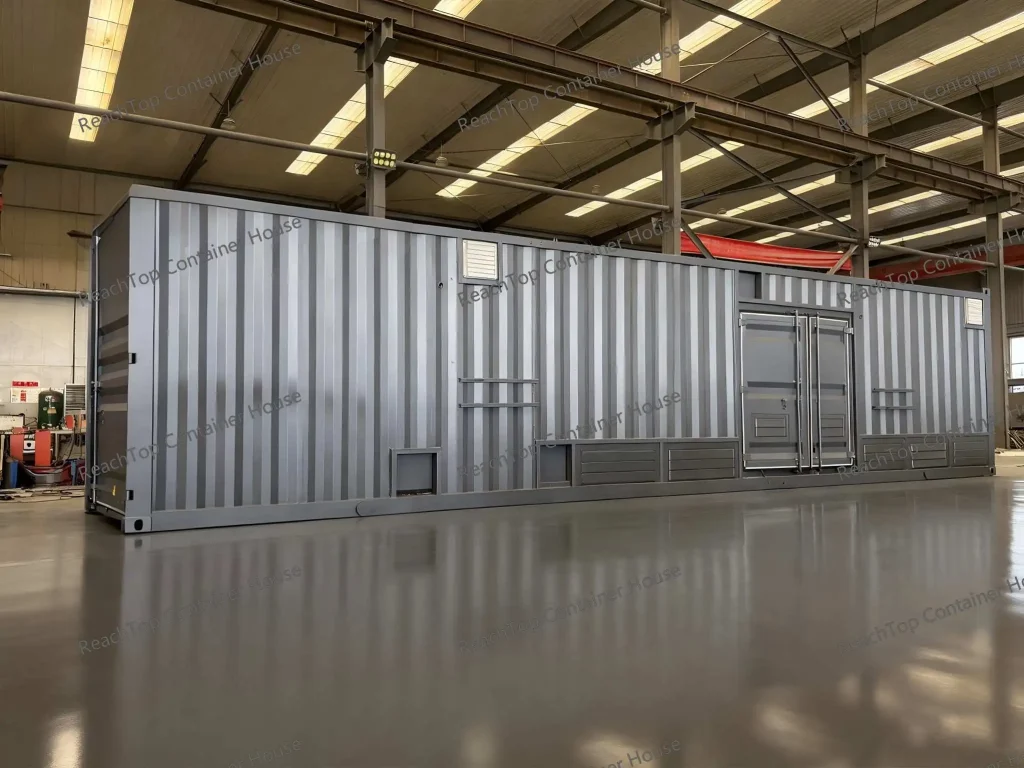
Let’s use a 40ft container as an example.
A brand-new 40ft shipping container with complete documentation currently costs approximately USD 5,200.
If ReachTop manufactures a 40ft container house structure with the same dimensions and a similar exterior appearance, the manufacturing cost is approximately USD 3,350.
The difference is roughly USD 1,850.
The reason is simple.
A genuine shipping container is an international freight asset.
Its cost includes:
- ISO container certification
- CSC approval plate
- Classification society inspection
- Customs registration
- International shipping compliance
- Global stacking and lifting standards
These certifications allow the container to be used for international cargo transportation, maritime shipping, customs clearance, and global logistics operations.
A container house is different.
Although it may look similar from the outside, it is designed as a building rather than a freight container. It does not need to participate in international cargo transportation and therefore does not require the certifications associated with global shipping equipment.
After the container arrives at the factory, the real work begins.
Whether the project starts with a genuine shipping container or a ReachTop-built container structure, the modification process is largely the same.
The container still needs:
- Thermal insulation
- Flooring
- Interior wall finishes
- Doors and windows
- Electrical systems
- Plumbing systems
- Bathroom installation
- Interior decoration
These costs are almost identical regardless of where the container shell comes from.
This means that for most projects, the main cost difference lies in the structure itself.
For a typical 40ft project, choosing a genuine shipping container will usually increase the budget by approximately USD 1,850 compared with a purpose-built container house manufactured by ReachTop.
The key distinction is not appearance.
The key distinction is purpose.
A shipping container is designed for transporting cargo around the world.
A container house is designed for people.
They may look similar, but they are fundamentally different products.
If your project requires a certified shipping container, ReachTop can source and convert one for you.
If your goal is simply to build a comfortable container home, office, shop, or accommodation unit, a purpose-built container house is often the more practical and cost-effective solution.
| Comparison Item | Genuine Shipping Container | ReachTop Container House |
|---|---|---|
| Primary Purpose | International Cargo Transportation | Residential & Commercial Buildings |
| Base Structure Cost (40ft) | Approx. USD 5,200 | Approx. USD 3,350 |
| ISO Certification | Included | Not Required |
| CSC Approval Plate | Included | Not Required |
| International Freight Use | Supported | Not Intended |
| Stacking & Lifting Certification | Included | Not Required |
| Insulation Installation | Required | Required |
| Doors & Windows Installation | Required | Required |
| Electrical System | Required | Required |
| Plumbing System | Required | Required |
| Interior Finishing | Required | Required |
| Typical Cost Difference | + USD 1,850 | Baseline Cost |
In most projects, customers are not paying for additional living comfort when choosing a genuine shipping container. They are paying for freight certifications that may never be used.