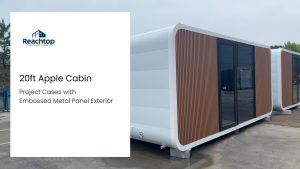

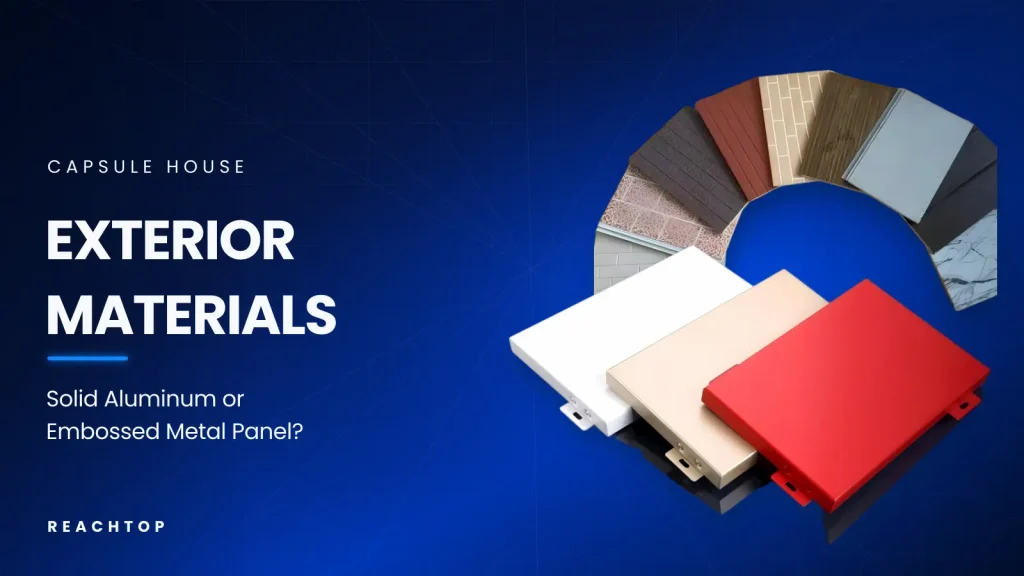
The term capsule house in this guide refers to Apple Cabin houses, Space Capsule houses and other prefabricated buildings customized with a capsule-shaped exterior. It does not refer to capsule hotel sleeping pods.
Five exterior materials are commonly offered for this type of prefabricated house:
- Embossed metal insulated panels
- Coated galvanized steel
- Aluminum composite panels
- Solid aluminum panels
- Fiberglass-reinforced plastic
ReachTop’s recommendation is straightforward:
- Choose embossed metal insulated panels for the lowest initial price.
- Choose coated galvanized steel for the best balance between price and quality.
- Choose solid aluminum panels for the highest exterior quality.
- Do not choose ACP or FRP unless the project has a specific reason to use them.
Exterior cladding and insulation are two major factors affecting the final capsule house price, so buyers need to understand what is included before comparing quotations.
Factory Experience Notice
This is not a generic materials encyclopedia. If you only need definitions, a Google search or an AI summary can provide them quickly. This guide is based on ReachTop’s factory procurement, fabrication and after-sales experience. It focuses on the decisions that affect price, appearance, manufacturing and long-term use.
Comparison of Five Capsule House Exterior Materials
| Exterior Material | Typical Construction | Main Advantages | Main Limitations | ReachTop Recommendation |
|---|---|---|---|---|
| Embossed Metal Insulated Panel | Embossed metal face, thin polyurethane core and foil backing, installed over a wall system with a separate main insulation layer and interior lining. | Lowest initial cost, decorative surface, fast installation and supplementary thermal and moisture resistance. | Lower-end appearance, visible panel joints and greater risk of dents or edge damage. | Best choice when the lowest purchase price is the priority. |
| Coated Galvanized Steel | Minimum 1.5 mm coated galvanized-steel exterior with a separate main insulation layer and interior lining. | Stronger surface, clean appearance, reliable fabrication and lower cost than solid aluminum. | Heavier than aluminum. Welds, cut edges and scratches require complete corrosion protection. | Best balance between price and quality. |
| Solid Aluminum Panel | Standard 2.0 mm formed aluminum exterior with PVDF coating, separate main insulation and interior lining. | Premium appearance, suitable for curved surfaces, no red rust, easy cleaning and strong long-term exterior value. | Higher material, forming, welding and coating costs. | Best choice for premium capsule houses. |
| Aluminum Composite Panel | Aluminum skins bonded to a composite core and installed over a supporting wall with a separate insulation system. | Lightweight, flat surface and a wide range of colours. | Little price advantage in our supply chain. Low-cost products often have thin aluminum skins, unclear core materials and weak edges. | Available as a custom option, but not recommended as a standard exterior. |
| FRP | Moulded fibre-reinforced resin shell installed over a supporting frame with separate main insulation and interior lining. | Suitable for curved and moulded exterior shapes. | Higher maintenance cost, yellowing risk and more difficult repairs around curved surfaces and window connections. | Available as a custom option, but not recommended as a standard exterior. |
* compares the exterior materials only. It does not mean that the selected exterior panel replaces the cabin’s main insulation system.
Exterior Cladding Does Not Replace the Main Insulation Layer
Every ReachTop Apple Cabin wall system includes a separate main insulation layer inside the wall structure. This also applies when the exterior uses an embossed metal insulated panel.
An embossed metal panel contains a thin polyurethane foam core, but that core is not the main insulation layer of the house. ReachTop treats it as a supplementary feature of the exterior panel, not as a substitute for the insulation installed inside the steel wall frame.
A complete wall system includes:
- Exterior cladding or decorative panel
- Supporting steel frame
- Main insulation layer
- Interior substrate or lining
- Interior decorative finish
Waterproofing details, air gaps and thermal-bridge treatment are added according to the selected wall system and project requirements.
A supplier that quotes an embossed metal panel without identifying the separate main insulation layer has not provided a complete wall specification.
The Two Most Recommended Exterior Panels
The two strongest choices are embossed metal insulated panels for low-cost projects and solid aluminum panels for premium projects. Coated galvanized steel sits between them and offers the best overall price-to-quality ratio.
Advantages and Disadvantages of Embossed Metal Insulated Panels
An embossed metal insulated panel has three layers:
- A coated and embossed galvanized-steel or aluminum face
- A thin high-density polyurethane foam core
- An aluminum-foil backing
Factory material prices start from approximately USD 6.50 per square metre. This is a factory procurement reference and does not include supporting frames, trims, sealants, installation labour or the main insulation installed inside the cabin wall.
Its advantages are clear:
- It is the lowest-priced exterior option.
- The embossed surface provides a finished decorative appearance.
- The polyurethane core adds supplementary thermal and moisture resistance.
- Large panels are quick to install.
- Many colours and surface patterns are available.
Its disadvantages are equally clear:
- The appearance does not suit a premium capsule house.
- The thin outer face is less robust than solid aluminum or coated galvanized steel.
- Corners and edges are easier to damage during production and transport.
- Panel joints remain visible.
- Repairs often produce a visible difference in colour or surface pattern.
Use embossed metal panels when the main objective is to control the purchase price. Do not rely on their thin polyurethane core as the house’s insulation system.
Advantages and Disadvantages of a Solid Aluminum Capsule House
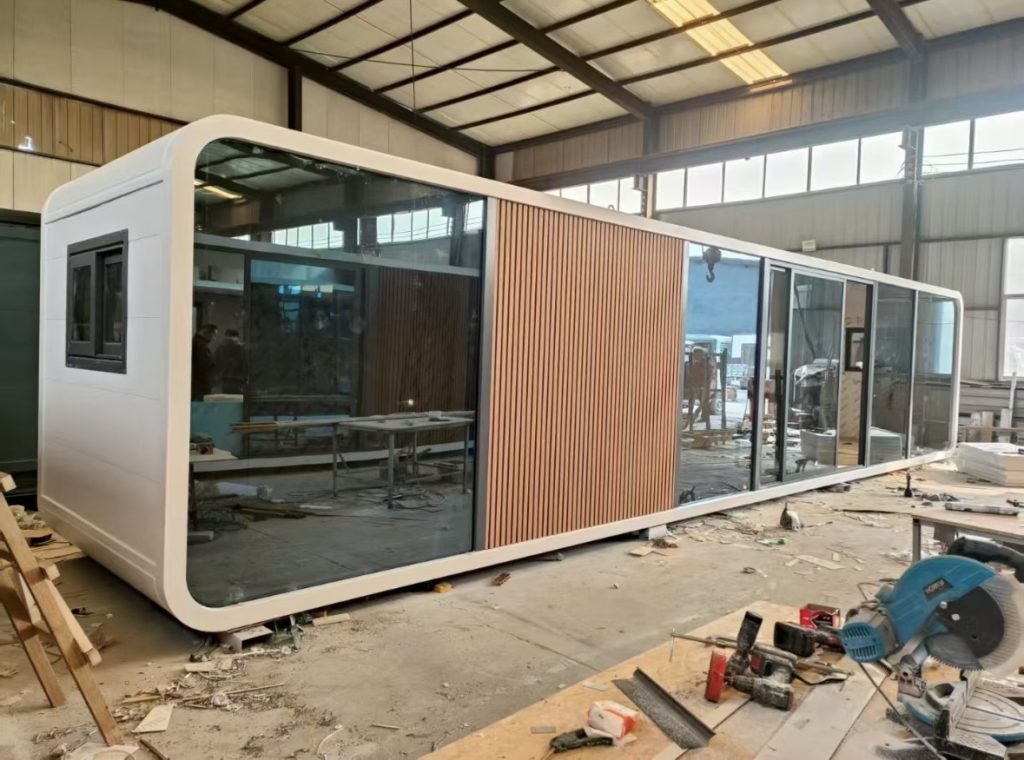
ReachTop uses 2.0 mm solid aluminum panels for standard premium Apple Cabin exteriors. This thickness is sufficient for standard production. Special geometry, large unsupported areas and project-specific structural loads require thicker aluminum or additional backing.
Solid aluminum offers several advantages:
- It produces the cleanest and most premium exterior appearance.
- It is suitable for curved surfaces and capsule-shaped corners.
- It does not develop red rust.
- The surface is easy to clean with water and mild detergent, much like washing a car.
- Damaged sections can be repaired or replaced individually.
- It provides better long-term exterior value than the other four options.
Its main disadvantage is price. The aluminum sheet, forming process, welding, surface preparation and coating system all cost more than galvanized steel or embossed metal panels.
For premium resorts, glamping projects, branded accommodation and high-end private units, solid aluminum is ReachTop’s first recommendation.
PVDF and FEVE Coating Systems
PVDF and FEVE are both used for aluminum exteriors, but ReachTop selects PVDF as the standard recommendation for premium solid-aluminum capsule houses.
PVDF provides the appearance, colour stability and weather resistance required for a long-term exterior finish. Qualified architectural PVDF systems use at least 70% PVDF resin in the binder and have more than 25 years of documented performance under severe ultraviolet exposure.
ReachTop retains FEVE as a customized coating option, but PVDF is our preferred specification for premium Apple Cabin exteriors.
Technical reference: Arkema Kynar 500 architectural coating specifications
Why Coated Galvanized Steel Offers the Best Balance
ReachTop uses coated galvanized steel with a thickness of at least 1.5 mm for this type of capsule house exterior.
It costs less than solid aluminum while offering a stronger and smoother exterior than embossed metal panels. It is the best choice for buyers who want better durability and appearance without paying for a complete solid-aluminum shell.
Its advantages include:
- Better impact resistance than thin embossed metal panels
- A smoother exterior finish
- Lower material cost than solid aluminum
- Reliable fabrication and replacement
- Multiple coating and colour choices
Its limitations are:
- It is heavier than aluminum.
- Cut edges, welds and scratches require complete corrosion protection.
- Damaged coating must be repaired promptly.
- Coastal and highly corrosive environments require an upgraded coating specification.
Galvanizing protects steel through both a barrier layer and sacrificial protection, but fabrication details still determine the long-term result. Buyers must check how the factory treats welds, cut edges, corners and installation damage.
Technical reference: American Galvanizers Association – corrosion resistance of galvanized steel
Why ReachTop Does Not Recommend ACP and FRP
Aluminum Composite Panels
ReachTop does not recommend ACP as a standard capsule house exterior.
In our current supply chain, ACP provides little price advantage over coated galvanized steel, while low-cost panels often use thin aluminum skins, unclear core materials and weak edge construction.
ACP remains available as a customized option. The quotation must state the total panel thickness, aluminum skin thickness, core material and coating specification.
Fiberglass-Reinforced Plastic
ReachTop does not recommend FRP as a standard capsule house exterior.
Its maintenance cost is higher, budget FRP shells commonly begin to yellow after approximately five to eight years in ReachTop’s experience, and repairs around curved surfaces and window connections are more difficult.
The statement that “FRP is used on yachts” does not prove the quality of a capsule house shell. Yacht-grade FRP depends on controlled resin selection, laminate construction, gelcoat quality and continuous maintenance.
FRP remains available as a customized option because some customers still prefer a fully moulded appearance.
Research also confirms that ultraviolet exposure causes resin yellowing and surface degradation in glass-fibre-reinforced polymer systems: Polymers journal study on UV ageing of GFRP
What Buyers Must Confirm Before Comparing Quotations
A quotation that only states “aluminum exterior” or “metal wall panel” is not detailed enough. Before comparing prices, buyers must confirm the complete wall specification.
| Item to Confirm | Information Required in the Quotation | Why It Matters |
|---|---|---|
| Exterior Material | Exact material type and grade, including whether it is solid sheet, composite panel, embossed panel or moulded FRP. | Similar-looking exterior materials have different costs, manufacturing methods and service lives. |
| Material Thickness | Steel or aluminum thickness. For ACP, the quotation must state both the total panel thickness and aluminum skin thickness. | Material thickness directly affects strength, appearance, fabrication quality and price. |
| Main Insulation Layer | Insulation material, thickness, density and location inside the wall system. | Every configuration requires a separate main insulation layer. The thin polyurethane core in an embossed exterior panel does not replace it. |
| Coating System | Coating type, supplier, colour, surface finish and relevant technical documentation. | The coating determines long-term colour stability, weather resistance and maintenance requirements. |
| Supporting Structure | Frame material, frame spacing, backing and reinforcement around openings and curved sections. | Exterior panels do not provide the complete wall structure by themselves. |
| Joints and Edges | Waterproofing method, trims, sealants, cut-edge treatment and window connection details. | Most exterior wall problems begin at joints, edges, penetrations and openings. |
| Interior Wall System | Interior substrate, decorative finish and service cavity arrangement. | A complete wall quotation must include both the exterior and interior wall construction. |
These details directly affect material cost, manufacturing quality, energy performance and maintenance. A lower quotation often reflects a thinner exterior skin, a lower-grade coating, reduced insulation or incomplete edge and joint treatment.
ReachTop’s Final Recommendation
The correct choice depends on the project position:
- For the lowest purchase price, choose an embossed metal insulated panel and retain a separate main insulation layer inside the wall.
- For the best balance between price and quality, choose coated galvanized steel with a thickness of at least 1.5 mm.
- For the highest exterior quality, choose 2.0 mm solid aluminum with a PVDF coating.
- Choose ACP or FRP only when the project has a clear design or procurement reason.
ReachTop manufactures both Apple Cabin houses and Space Capsule houses. Exterior materials, coating systems, insulation and interior finishes can be configured for different project levels.
For factory inspection, production control, drawing confirmation and after-sales information, see ReachTop’s service process.
Frequently Asked Questions
Does an aluminum exterior make a capsule house better insulated?
No. Aluminum provides the exterior finish and weathering surface, but it is not the main insulation layer. Thermal performance depends on the insulation material and thickness, thermal bridges, windows, roof, floor, ventilation and overall wall assembly.
Is a 2.0 mm aluminum panel thick enough?
For common capsule house cladding, 2.0 mm aluminum is normally sufficient when it is supported and fixed correctly. Large panels, unusual curves, high wind requirements or wider support spacing may require a different thickness or reinforcement.
Is every aluminum composite panel unsuitable?
No. High-quality ACP with documented aluminum skins, a suitable mineral core and an architectural coating can perform well. ReachTop’s concern is mainly with low-cost, unspecified ACP commonly offered without clear core, skin-thickness or coating information.
Is FRP always a poor material?
No. A properly engineered FRP system can be durable. Its performance depends heavily on resin, fiber reinforcement, gelcoat, UV protection, manufacturing quality and maintenance. Buyers should not assume that every molded FRP shell has the same quality as a marine or industrial composite product.