
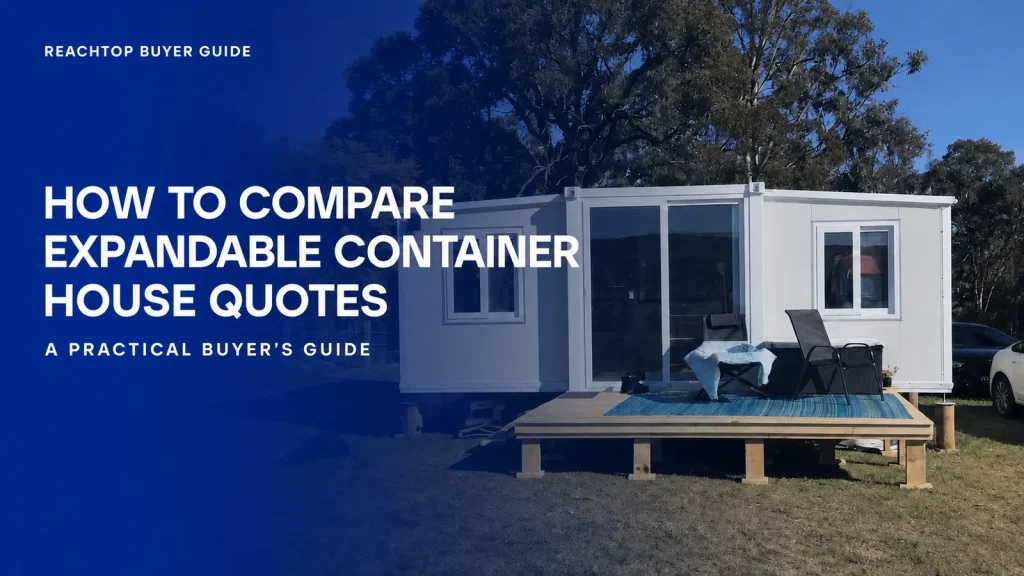
Why can two factory quotations for a 20ft expandable container house differ by several thousand dollars?
This is one of the most confusing questions for buyers entering the market. The difference does not necessarily mean that one supplier is reasonable and the other is not. More often, the two factories are using the same product name for houses with very different wall finishes, insulation, windows, flooring, bathrooms and levels of completion.
Using a typical 20ft expandable container house as an example, this guide explains where the price difference comes from and how to confirm whether two factories are actually quoting the same product.
Important: Scope of This Guide
This article covers the common export configurations offered by Chinese expandable container house factories. It does not provide pricing for houses engineered for Australia’s NCC or Class 1a requirements, or for projects designed around other mandatory building codes.
Code-specific projects may require a modified structural system, different wall and roof assemblies, fire and energy-efficiency measures, compliant electrical and plumbing systems, engineering documents and local professional review. For an NCC/Class 1a-ready configuration or another code-specific solution, contact sales@reachtophouse.com for a separate assessment and quotation. The basic comparison principles in this article can still be used as a starting point.
If you are not yet familiar with how these houses work, start with our expandable container house overview to see the common sizes, layouts and folding structure.
Before Comparing Prices, Understand One Basic Fact
Every factory has different purchasing costs, production efficiency, management expenses, profit requirements and order schedules. A completely uniform market price does not exist, and a small difference between suppliers is normal.
The real problem is that the expandable house industry does not use a uniform way of describing configurations.
A quotation may say only “20ft expandable house with bathroom” without explaining whether the exterior has decorative cladding, whether the windows are standard aluminium or thermal-break aluminium, whether the floor is PVC or SPC, where the insulation is installed, or what the bathroom package actually includes.
The buyer sees the same product name, but the factories may be pricing two very different scopes of supply.
Unless another material is specified, the main frame of a common export-model expandable house is generally made from Q235 steel. However, seeing the same steel grade and the same material names on two quotations does not mean the finished houses are identical. The specifications, coverage and completion level of those materials may still differ.
Buyers are not expected to evaluate structural sections or perform engineering calculations themselves. For an ordinary quotation comparison, the first task is simply to confirm whether the dimensions, layout, materials, finishes and delivery scope are the same.
Three Common Configuration Levels
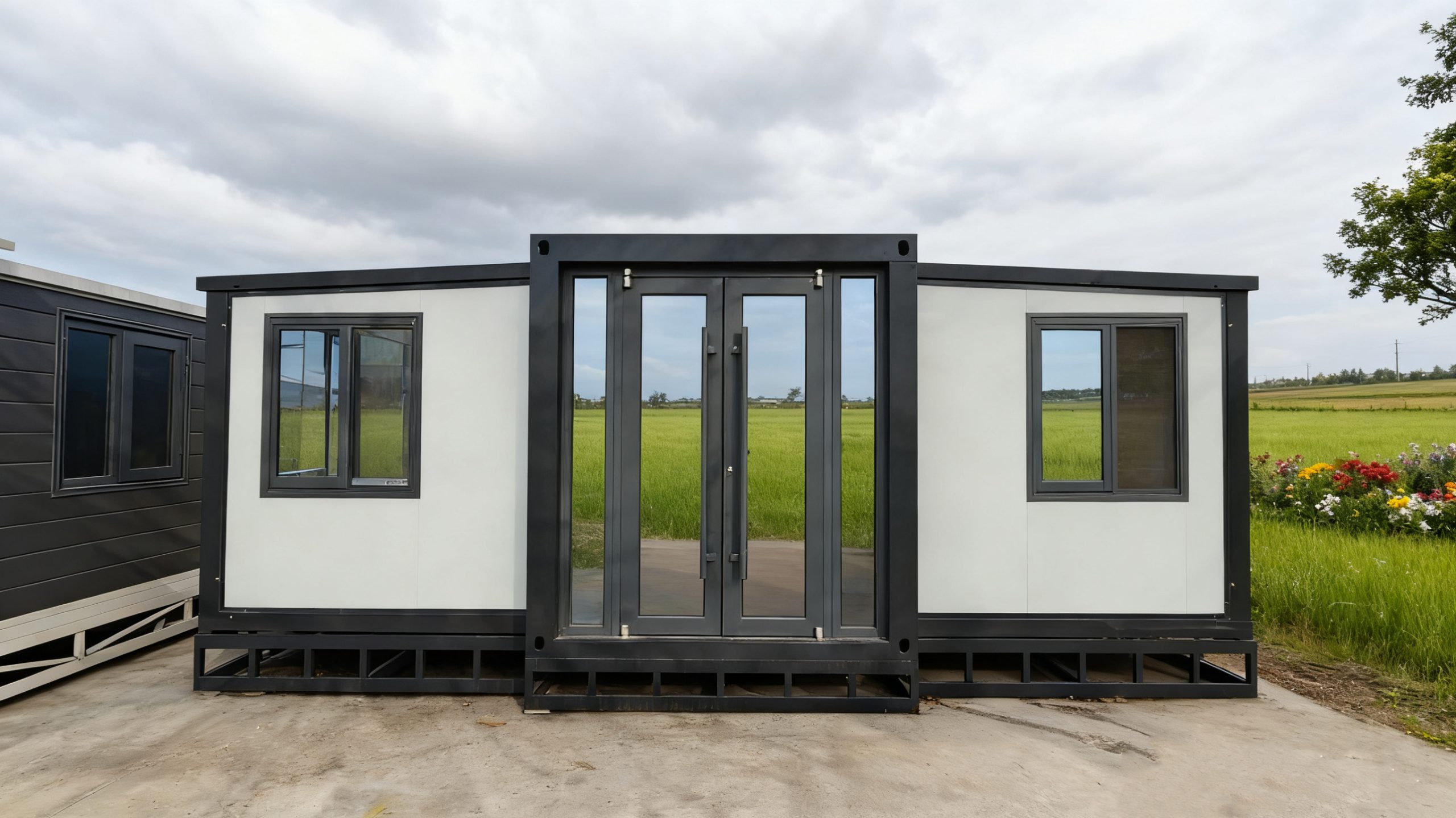
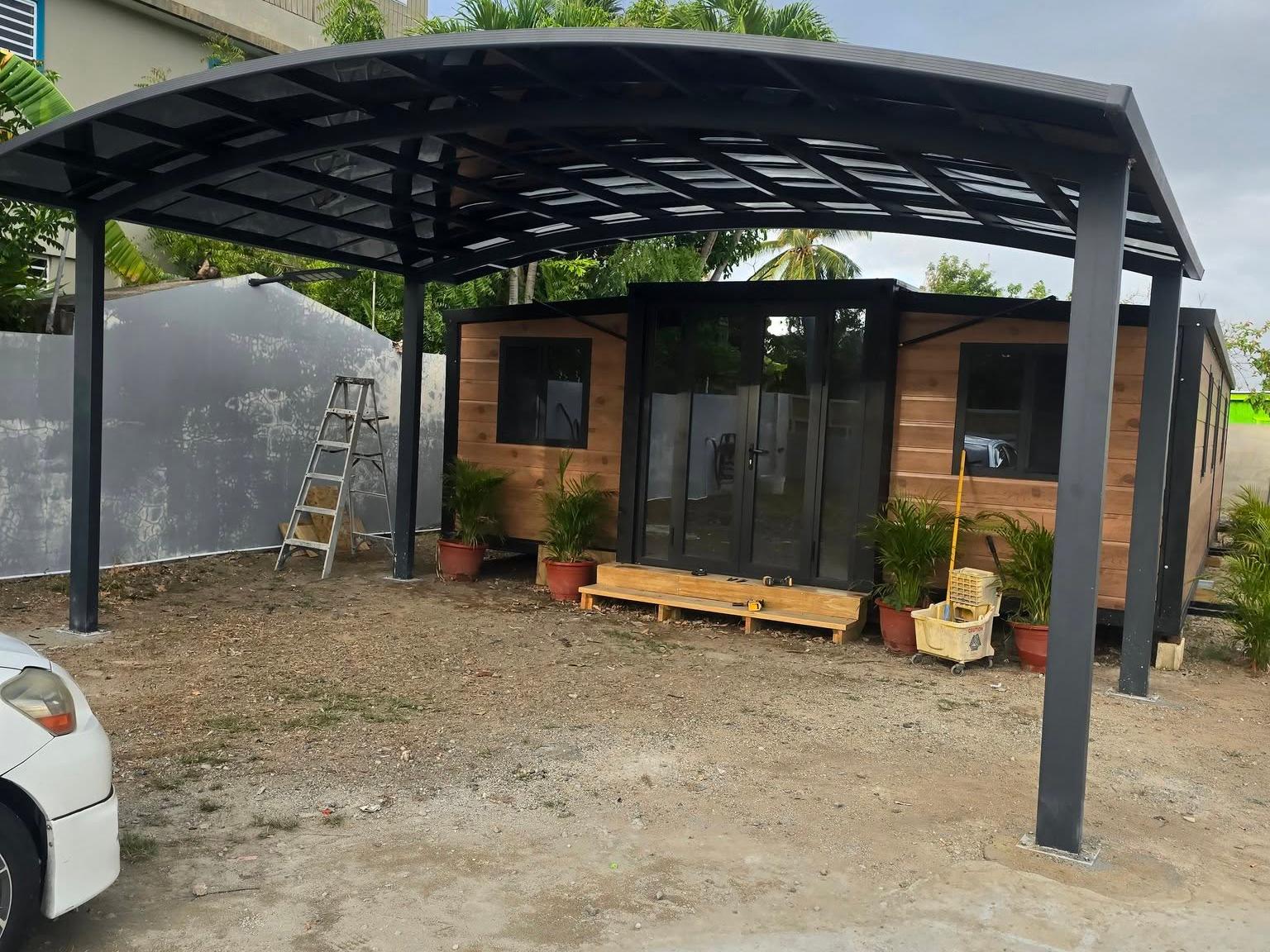
To make the differences easier to understand, ReachTop groups common 20ft expandable container house configurations into three levels: Basic, Luxury and Premium.
These are ReachTop’s own comparison categories, not standardized industry grades. Other factories may use completely different names, so the written specification should always take priority over the package name.
The window quantities below represent typical layouts and may change slightly with the floor plan.
Basic Configuration
Luxury Configuration
Premium Configuration
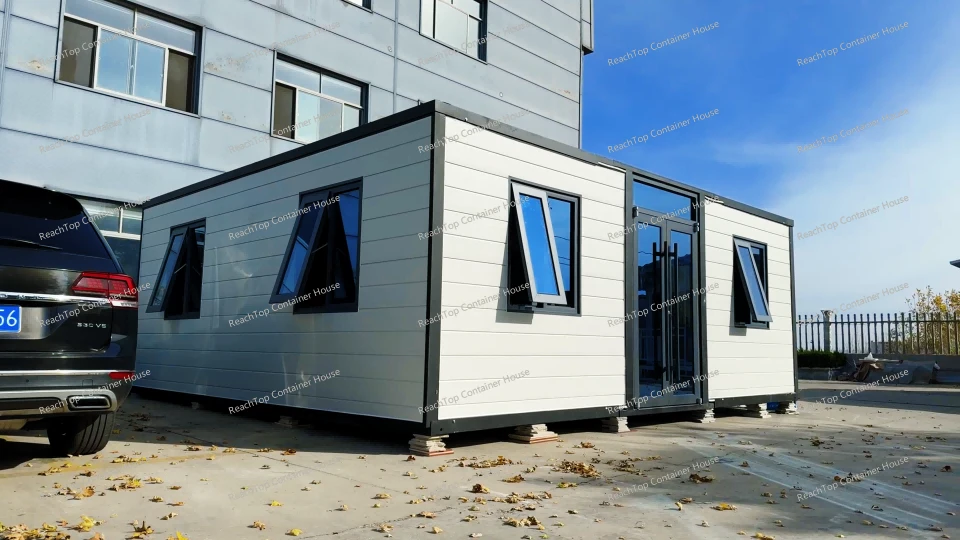
The house size has not changed across these three levels. What changes is the exterior and interior finish, window performance, flooring, bathroom specification and insulation coverage.
The Premium configuration described here is still a conventional export configuration. It is not the same as an NCC/Class 1a-ready system or a higher-level engineered solution using a flat roof, 100mm polyurethane insulation and project-specific technical documentation.
Reference FOB Prices for a 20ft Expandable Container House
The following figures are based on the typical 20ft configurations calculated through ReachTop’s current expandable house price calculator.
All prices are FOB Qingdao references. They do not include ocean freight, destination charges, import duties, inland transport, foundations, lifting, on-site installation or local approvals.
| Configuration | Reference FOB Price | Difference from Previous Level | Main Upgrades |
|---|---|---|---|
| Basic | USD 7,535 | — | EPS wall panels, standard aluminium windows, PVC flooring and standard bathroom |
| Luxury | USD 9,602 | +USD 2,067 | Exterior and interior wall finishes, thermal-break windows and upgraded bathroom |
| Premium | Approx. USD 13,503 | Approx. +USD 3,901 | SPC flooring, 50mm polyurethane wall insulation and underfloor insulation |
The calculator does not currently include polyurethane insulation as a separate line item, so the Premium price requires an additional estimate.
For a typical 20ft expandable house, the estimated insulation area is:
- Two long exterior walls: approximately 29.3 m²
- Two short exterior walls: approximately 31.2 m²
- Underside of the floor: approximately 37 m²
- Total estimated area: approximately 97.5 m²
Based on 50mm polyurethane insulation at USD 35 per square metre:
97.5 × USD 35 = USD 3,412.50
The SPC flooring upgrade is estimated at USD 13.21 per square metre:
37 × USD 13.21 = USD 488.77
The estimated Premium price is therefore:
USD 9,602 + USD 3,412.50 + USD 488.77 = USD 13,503.27
For practical quoting, this can be shown as approximately USD 13,500.
This calculation covers the exterior walls and underside of the floor, but not the roof. Actual material consumption may change with the window and door openings, application method, production loss and confirmed project requirements.
How Much Price Variation Is Normal?
An expandable container house is not a completely standardized retail product. Steel and material costs, exchange rates, order quantity, layout, window quantity, bathroom specification, packaging method and quotation validity can all affect the final price.
For that reason, a difference of several hundred dollars between two quotations can be normal. In some cases, the difference may approach USD 1,000 without indicating a serious problem.
However, if two suppliers have confirmed the same trade term, dimensions, layout, materials and delivery scope, but their prices still differ by several thousand dollars, the buyer should investigate further.
The lower quotation may exclude part of the configuration or use a more basic specification. The higher quotation may include upgrades that have not been clearly shown, or it may simply contain a higher profit margin.
A low price is not automatically an opportunity, and a high price is not automatically proof of quality. The important point is to make every supplier state clearly what the quotation includes.
Check These Eight Items Before Comparing Quotations
1. Are the Trade Terms the Same?
EXW, FOB and CIF prices cannot be compared directly.
Even when both quotations are FOB, confirm that they use the same Chinese port and that customs declaration, port charges and container loading are included on the same basis.
2. Are the Dimensions and Layout the Same?
Confirm whether the house is 20ft, 30ft or 40ft and whether the expanded dimensions are identical.
Check the number of bedrooms and bathrooms and whether the kitchen, internal partitions and interior doors are included. Layout changes directly affect both material and labour costs.
3. Does the Wall Specification Describe the Complete Assembly?
“EPS wall panel” describes only the base wall material. It does not tell the buyer whether exterior decorative cladding, bamboo-fibre interior panels or carbon-crystal panels have been added.
If polyurethane insulation is included, confirm its thickness and whether it covers the walls, roof, floor or underside.
4. Are the Window Quantity and Specifications the Same?
Standard aluminium windows and thermal-break aluminium windows do not have the same cost.
Confirm the number and size of the windows, the glass specification and whether the small bathroom window has been included in the total.
5. Is the Flooring System the Same?
Confirm whether the quotation uses PVC flooring, SPC flooring or another finish, and whether the floor substrate is included.
A description such as “finished floor” is not detailed enough for a meaningful comparison.
6. What Does the Bathroom Package Include?
A standard bathroom and an upgraded bathroom may use different wall finishes, flooring, shower areas, sanitary fixtures, vanity units and doors.
Do not compare quotations only by checking whether the word “bathroom” appears on both documents.
7. What Is Excluded from the Price?
Confirm whether furniture, appliances, air conditioners, water heaters, kitchens, decks, additional roofs, shipping, foundations, lifting and on-site installation are included.
The lowest advertised price normally does not include all of these items.
8. Can the Final Configuration Be Confirmed in Writing?
Before paying a deposit, ask the factory to provide a configuration list, floor plan and photographs of a comparable finished unit that can be confirmed with the contract.
After production, use the same documents during the pre-shipment inspection. Verbal promises are not enough to resolve a configuration dispute after delivery.
A Frank Note from ReachTop
ReachTop has worked with expandable container houses for many years and regularly communicates with other companies in the industry. Buyers also send us quotations from other suppliers. Some factories are slightly cheaper than us, while some sellers are more expensive. That is normal.
We also work to keep our prices down, but not by quietly removing the configuration that was promised. Some differences are difficult to see in a sales photograph. The value of better windows, insulation, flooring, waterproofing and bathroom work often becomes much clearer after the house has been used for one or two years.
Expandable houses made in China are competitively priced, but they are not as cheap as some advertising makes them appear. Buyers should not expect to receive a complete, comfortable and durable house at an impossibly low price.
Price alone cannot prove quality, but real materials and proper manufacturing work do not come for free. If an offer appears far below the normal range, something has usually been reduced, excluded or left unclear.
The goal is not to choose the most expensive house. It is to understand exactly what you are paying for.
If indoor comfort and long-term residential use matter to your project, the Luxury or Premium configuration will usually be more suitable than the Basic configuration.
Once again, these three names are ReachTop’s own way of organizing the comparison; they are not universal market grades. The final purchasing decision should always return to the confirmed materials, quantities, specifications and delivery scope.
If you are comparing expandable container house quotations from different factories, send the project location, quantity, layout and target configuration to sales@reachtophouse.com.
ReachTop can recalculate the project using one consistent specification so that you are comparing the same house rather than two different products with the same name.