
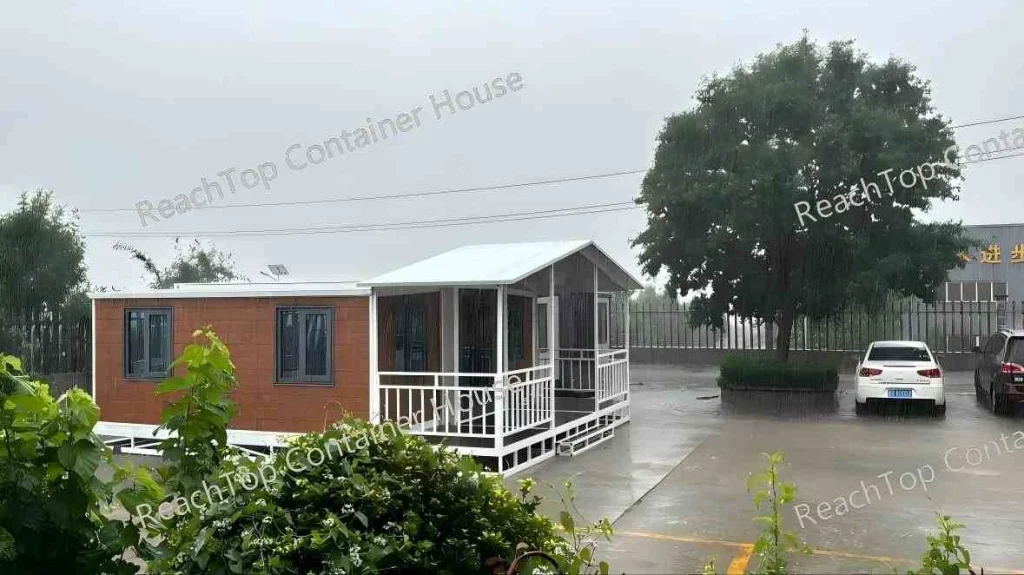
Yes, an expandable container house can leak.
The most common leakage points are:
- The folding joints on the roof
- The connection between the wall panels and the floor
- Windows
- The shower area
However, these are only the locations where water becomes visible. The real causes usually begin much earlier, during product design and manufacturing.
From our experience, most water leakage problems in an expandable container house come from three things:
- Incorrect structural dimensions
- Low-quality materials
- Careless manufacturing and installation
Sealant, waterproof tape and additional waterproofing procedures are useful. But they cannot completely compensate for an incorrectly designed structure or poor workmanship.
If an expandable container house is expected to remain in use for many years, the best solution is not simply applying more sealant.
The most effective long-term solution is to install an additional roof above the expandable house.
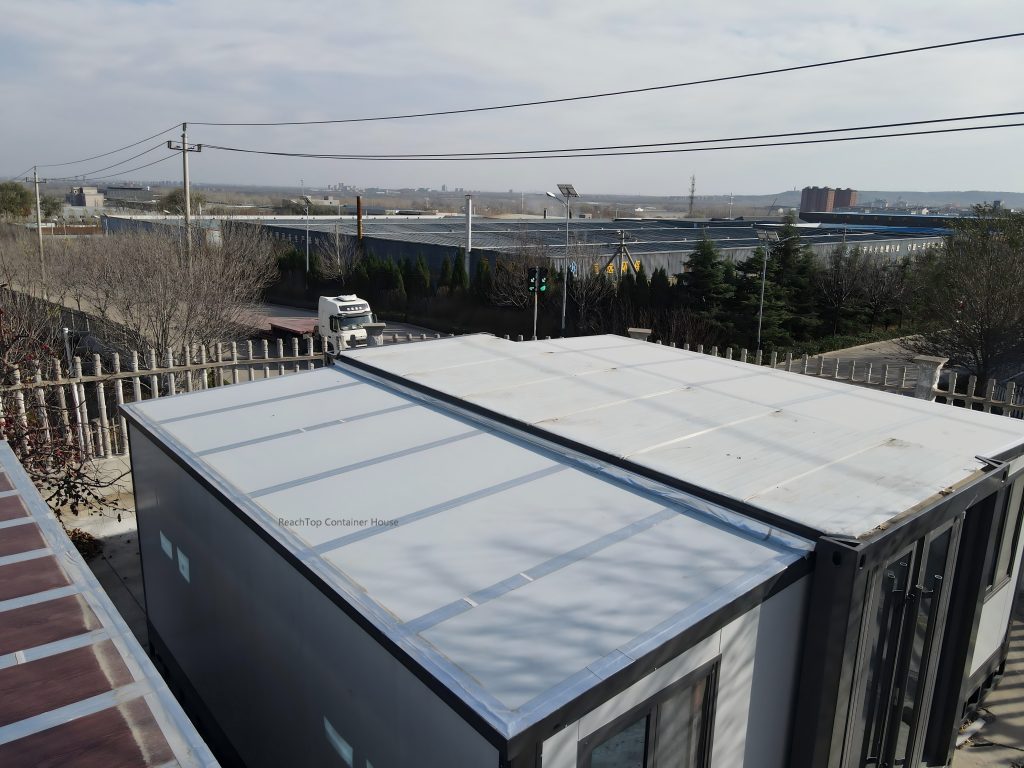
1. Leakage at the Folding Joints
The roof of an expandable container house contains folding sections. These joints allow the house to be folded for transportation and expanded after delivery.
They are also among the most common leakage points.
A properly manufactured folding joint normally requires:
- Accurate steel-frame dimensions
- Correct roof-panel positioning
- Waterproof rubber strips
- Butyl waterproof tape
- Properly applied sealant
- Correct bolt installation
- Adequate roof drainage
If the structural dimensions are inaccurate, the roof sections may not close tightly after the house is expanded.
Even a small gap can allow rainwater to enter during heavy rain or strong wind.
This is why leakage at a folding joint is not always just a sealing problem. It may be caused by a structural design or manufacturing error.
Adding more sealant may temporarily reduce the leakage, but it does not correct the original dimensional problem.
2. Water Entering Between the Wall Panel and Floor
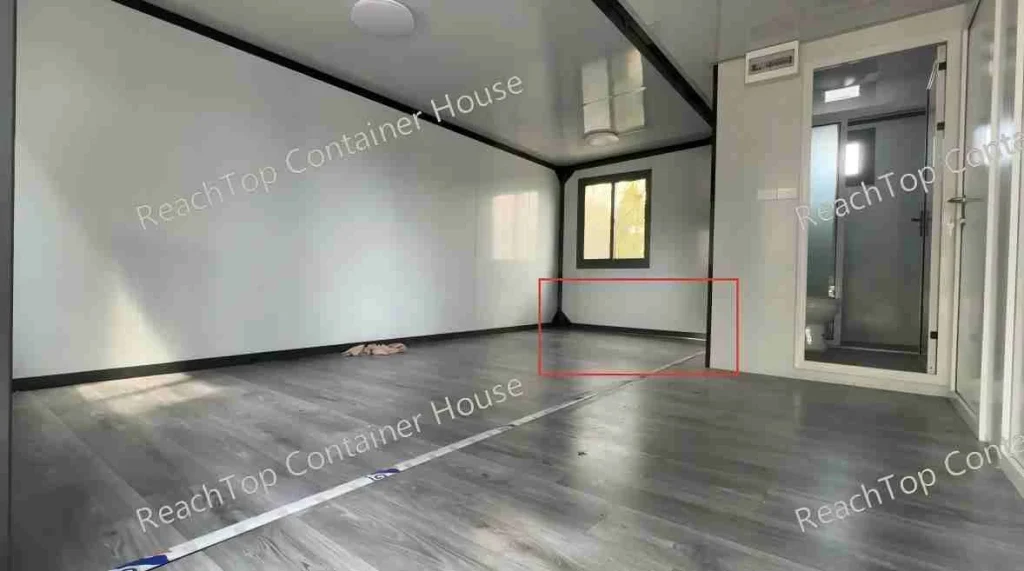
Another common problem appears where the wall panel meets the floor structure.
If the wall panel is too short, the floor edge is incorrectly designed, or the gap between the two components is too large, rainwater can be pushed into the house by wind.
This type of leakage is particularly common during:
- Wind-driven rain
- Storms
- Long periods of rainfall
- Installation on an uneven foundation
The water may not immediately appear inside the room.
It can first enter the floor edge or insulation layer and only become visible later. This makes the problem more difficult to identify and repair.
A reliable expandable container house requires accurate structural dimensions from the beginning.
Waterproof tape and sealant should be treated as additional protection. They should not be used to hide an oversized gap caused by poor design or inaccurate production.
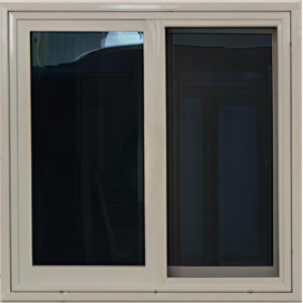
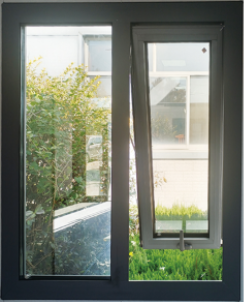
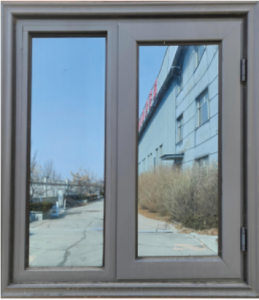
3. Window Leakage
Many buyers believe that upgrading to thermal-break aluminium windows automatically solves the problem of window leakage.
It does not.
There is a significant quality difference between one thermal-break aluminium window and another.
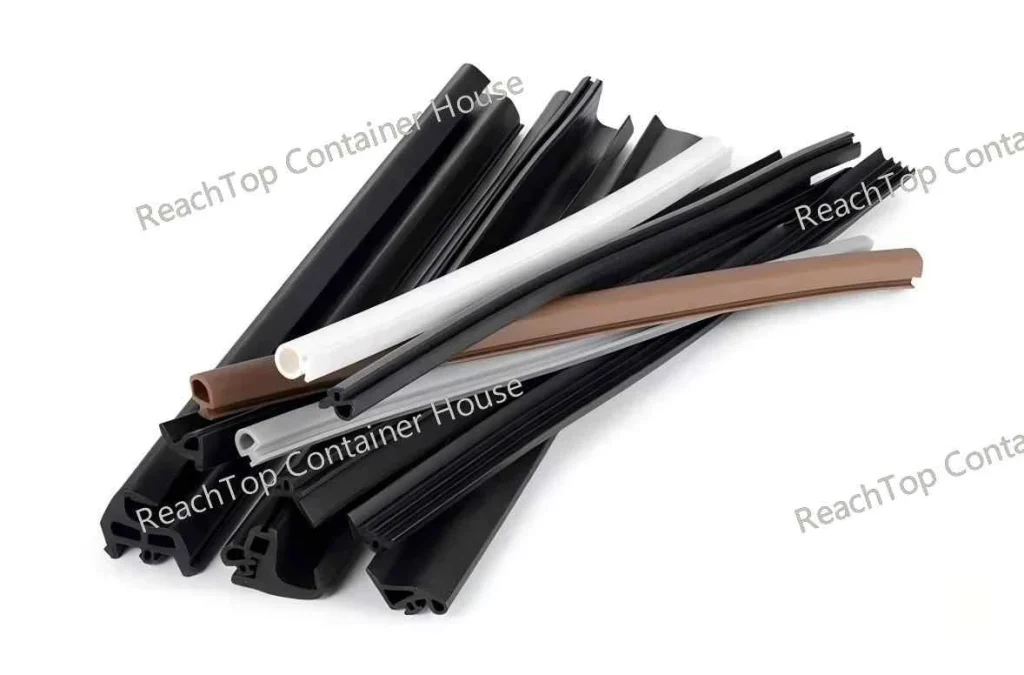
One of the most important details is the material used for the window sealing gaskets.
Ask the supplier a direct question:
Are the window sealing gaskets made from EPDM rubber or PVC?
For long-term exterior window sealing, we recommend EPDM, or ethylene propylene diene monomer rubber.
EPDM is widely used for outdoor sealing because it performs better under sunlight, temperature changes, rain and long-term weather exposure.
PVC sealing strips are not a good choice for expandable container house windows.
PVC gaskets are more likely to:
- Harden over time
- Lose elasticity
- Shrink after long-term exposure
- Crack under temperature changes
- Create gaps around the window frame
- Increase the risk of water leakage
A window may appear properly sealed when the house leaves the factory. But if low-quality PVC sealing strips are used, the gasket may gradually become hard and lose contact with the aluminium frame.
Once this happens, rainwater can enter around the glass or window frame.
Therefore, when inspecting thermal-break aluminium windows, do not only ask whether the window is made from thermal-break aluminium.
You should also confirm that the sealing gaskets are made from EPDM.
You should additionally check:
- Whether the window frame has drainage holes
- Whether the drainage holes are correctly positioned
- Whether the drainage holes are blocked
- Whether the frame is installed level
- Whether the external sealant is continuous
- Whether there are gaps at the four corners
- Whether the window opening matches the frame dimensions
A good window can still leak if it is installed poorly.
But even good installation cannot completely compensate for low-quality sealing materials.
4. Shower Area Leakage
Leakage in the shower area is more serious than many buyers expect.
Water does not always remain on the visible bathroom floor.
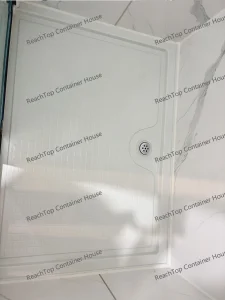
It can enter through the joints around the shower tray, wall panels, drainage outlet or bathroom floor.
Once water enters the insulation layer, it may cause:
- Persistent moisture
- Unpleasant smells
- Mould
- Damage to the internal floor
- Corrosion of steel components
- Reduced insulation performance
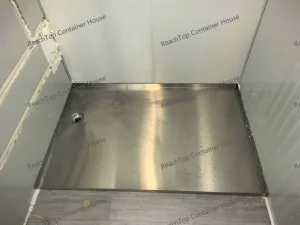
Our solution is to install a stainless-steel water collection tray beneath the lower part of the shower area.
The purpose of this tray is to create an additional protective layer.
Even if a small amount of water passes through the visible bathroom surface, the stainless-steel tray helps prevent it from entering the insulation layer and internal floor structure.
The bathroom should also include:
- A correctly sloped floor
- A reliable floor drain
- Sealed wall-to-floor joints
- Waterproof treatment around pipe penetrations
- A complete drainage test before delivery
A visually attractive bathroom does not prove that the waterproofing is reliable.
The hidden structure underneath is more important.
The Three Real Causes of Leakage
Although water can enter from several locations, the root causes can usually be reduced to three categories.
Poor Structural Design
The wall panels, floor, roof and folding joints must fit together accurately.
If the dimensions are wrong, the installer may be forced to fill oversized gaps with sealant, foam or waterproof tape.
That is not waterproof engineering.
It is damage control.
A small dimensional error in the factory may become a serious leakage problem after the house has been transported, expanded and exposed to wind and rain.
If two structural components do not fit together correctly, no amount of sealant can provide the same long-term reliability as an accurately manufactured connection.
Low-Quality Materials
Cheap materials can reduce the initial purchase price, but they also shorten the effective waterproofing life of the house.
Examples include:
- Low-grade sealant
- Thin waterproof tape
- PVC window sealing strips
- Low-quality screws
- Weak roof panels
- Inadequate galvanising
- Bathroom materials not suitable for long-term wet conditions
Some low-cost expandable container houses look acceptable when they leave the factory.
The difference only becomes visible after several months or years outdoors.
For example, a PVC window gasket may initially look similar to an EPDM gasket. But after long-term exposure to sunlight and temperature changes, PVC is more likely to harden, shrink and lose its sealing performance.
Material quality is therefore not just about appearance at the time of delivery.
It is about how the product performs after years of use.
Careless Workmanship
Even a good structural design can fail when the manufacturing process is poorly controlled.
Typical workmanship problems include:
- Missing sealant
- Broken waterproof tape
- Uneven screw spacing
- Overtightened screws
- Loose screws
- Misaligned wall panels
- Incomplete bathroom sealing
- Blocked window drainage holes
- Damaged coatings around drilled holes
- Poorly installed window gaskets
Waterproofing depends on many small details.
Missing one detail may not cause an immediate problem, but it can create a weak point that later develops into leakage.
The Best Way to Prevent Roof Leakage
Technical departments and sales teams often tell buyers that the solution is to optimise the structure, improve the waterproofing process, apply more sealant and install waterproof tape.
All of these measures are useful and necessary.
But if the expandable container house will be used for many years, the most effective solution is still very simple:
Install an additional roof above the expandable container house.
A separate roof physically prevents most rainwater from reaching the folding joints and original roof surface.
This is more reliable than allowing rainwater to continuously reach the original roof and expecting sealant and waterproof tape to resist it forever.
An additional roof also provides several other benefits:
- Better thermal insulation
- Lower indoor temperatures in summer
- Reduced heat loss in winter
- Better sound insulation during rain
- Lower condensation risk
- Longer waterproofing life
- Better external appearance
- Additional protection for roof sealant and waterproof tape
Instead of repeatedly repairing the waterproofing layer, an additional roof reduces the amount of water reaching the original roof in the first place.
In our opinion, this is one of the most valuable upgrades for an expandable container house.
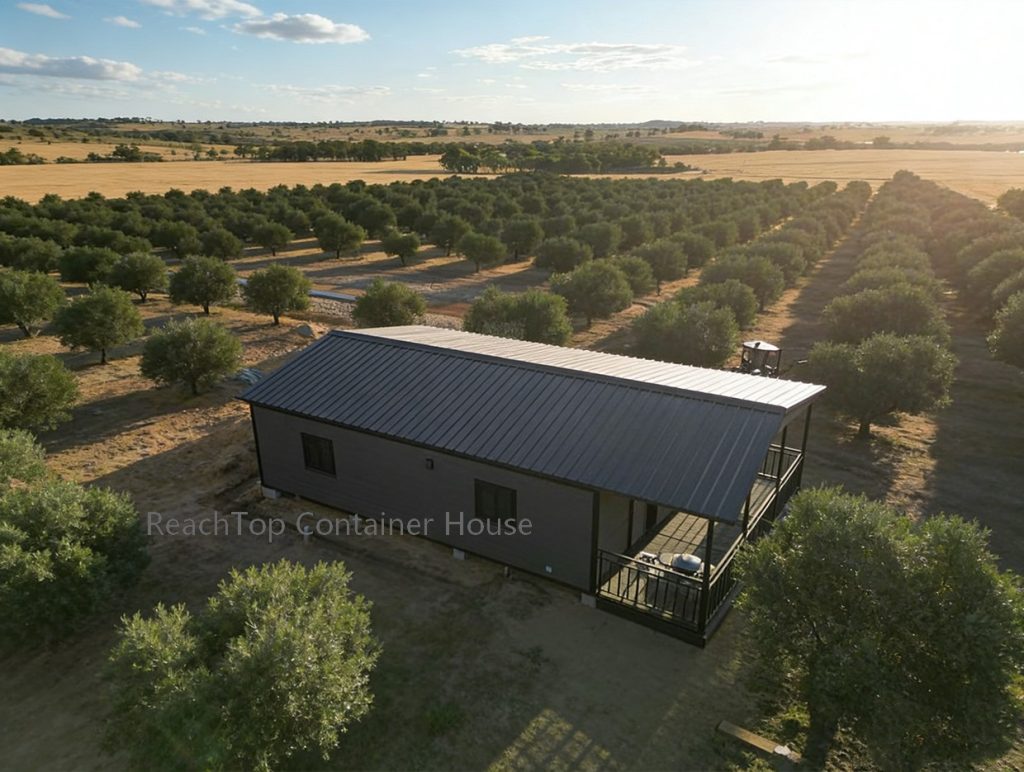
A Warning About Flat-Roof Expandable Container House
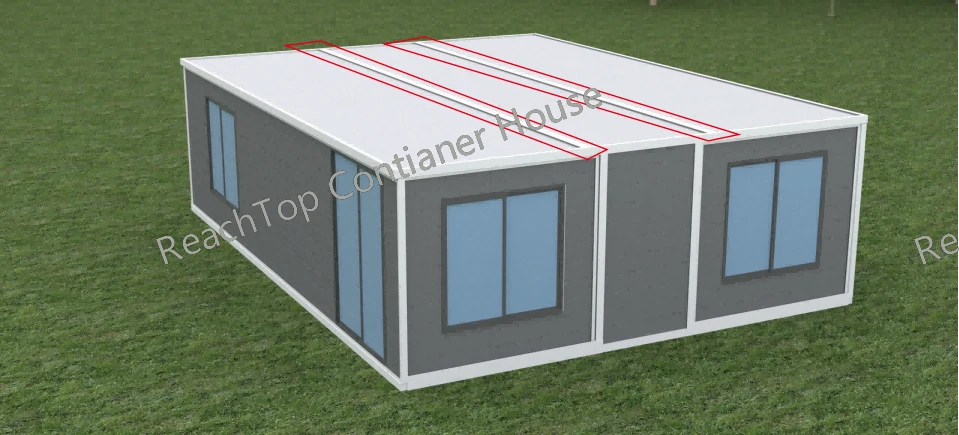
If you are purchasing a flat-roof expandable container house with an internal height of approximately 2.4 metres, an additional roof should not be treated as an optional accessory.
It should be treated as a required configuration.
A flat roof has less natural drainage capacity than a sloped roof.
Water remains on the roof for longer, and any small installation error, local depression or blocked drainage area increases the risk of standing water.
Once water remains above a folding joint, screw position or sealed connection for a long period, the waterproofing pressure becomes much higher.
For a flat-roof expandable container house, relying only on sealant and waterproof tape is not a sensible long-term strategy.
Add a separate roof.
How to Check Whether an Expandable House May Leak
Many people will tell you to visit the factory in China.
That advice sounds useful, but there is a practical problem.
If you are not familiar with expandable container houses, what exactly should you inspect?
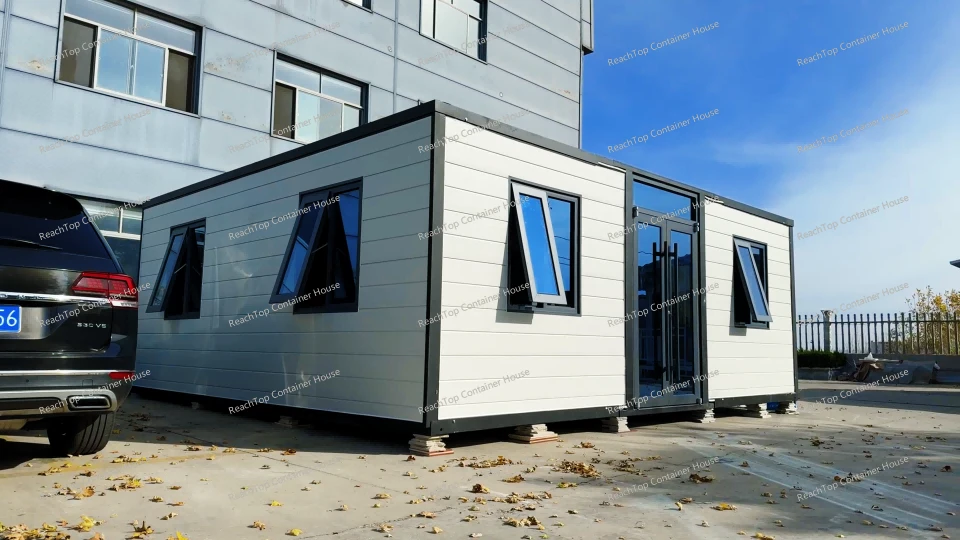
One of the simplest methods is to inspect the expandable house samples stored outdoors in the factory yard.
Do not only inspect a newly completed house inside the showroom.
Look for a sample that has remained outdoors through rain, sunlight and temperature changes.
Then inspect the screw positions, windows, folding joints and internal corners.
Check the Screws to Find a Real Outdoor Sample
One of the simplest ways to judge whether an expandable container house has truly remained outdoors for a long time is to inspect the screws.
When screws are drilled and fastened into the steel structure, the drilling process may locally damage the powder-coated surface and galvanised layer around the screw holes.
After long-term exposure to rain, humidity and changing weather conditions, a small amount of rust may gradually appear around some screw positions.
This is normal.
A few minor rust marks around the screws do not mean that the expandable container house is leaking or that the entire corrosion-protection system has failed.
Instead, these marks can help you confirm that the sample has not just been placed outside for several days before your visit. It has probably remained outdoors for a much longer period and has experienced real rain, sunlight, humidity and temperature changes.
This is exactly the type of sample you should inspect.
The important question is not simply:
Are there any rust marks around the screws?
The more useful questions are:
- How long has this expandable house remained outdoors?
- Does the interior still remain dry?
- Are there any water stains on the ceiling or walls?
- Has the flooring swollen or deformed?
- Is there any mould or persistent moisture?
- Are the windows and folding joints still performing properly?
A sample with a few normal rust marks around the screw holes, but no internal leakage or water damage after long-term outdoor exposure, can provide more useful information than a completely new house inside a showroom.
Why Long-Term Outdoor Samples Matter
An expandable container house stored outdoors is being tested by real weather every day.
Rain, wind, sunlight, humidity and repeated temperature changes expose problems that may not appear during a short factory inspection or showroom visit.
A newly completed expandable container house can look perfect.
The sealant is still new, the waterproof tape has not aged, the flooring has not been exposed to moisture, and the windows have not experienced repeated heat and cold cycles.
That appearance tells you very little about its long-term performance.
An older outdoor sample is much more valuable.
Look for an expandable house that has clearly remained in the factory yard for several months or longer. Minor rust marks around some screws can help confirm its age and outdoor exposure.
Then inspect whether the house is still in normal condition.
Check:
- The roof folding joints
- Roof and wall screw positions
- Window corners
- Window sealing gaskets
- Door frames
- Wall-to-floor connections
- Internal ceiling corners
- Bathroom floor edges
- Flooring close to the external walls
- Water stains
- Mould
- Swollen or deformed flooring
- Persistent moisture or unusual smells
The logic is very simple.
No manufacturer wants to leave a seriously leaking expandable container house in the yard where visiting customers can inspect it.
If an older sample has experienced long-term wind and rain, remains outdoors in full view, and still has a dry interior without obvious water damage, this usually shows that the manufacturer has confidence in the product.
Do not be distracted by a few small rust marks around drilled screw holes.
Those marks may simply prove that you are looking at a genuinely weather-tested sample rather than a newly prepared showroom product.
Time and real weather are often more reliable than sales presentations.
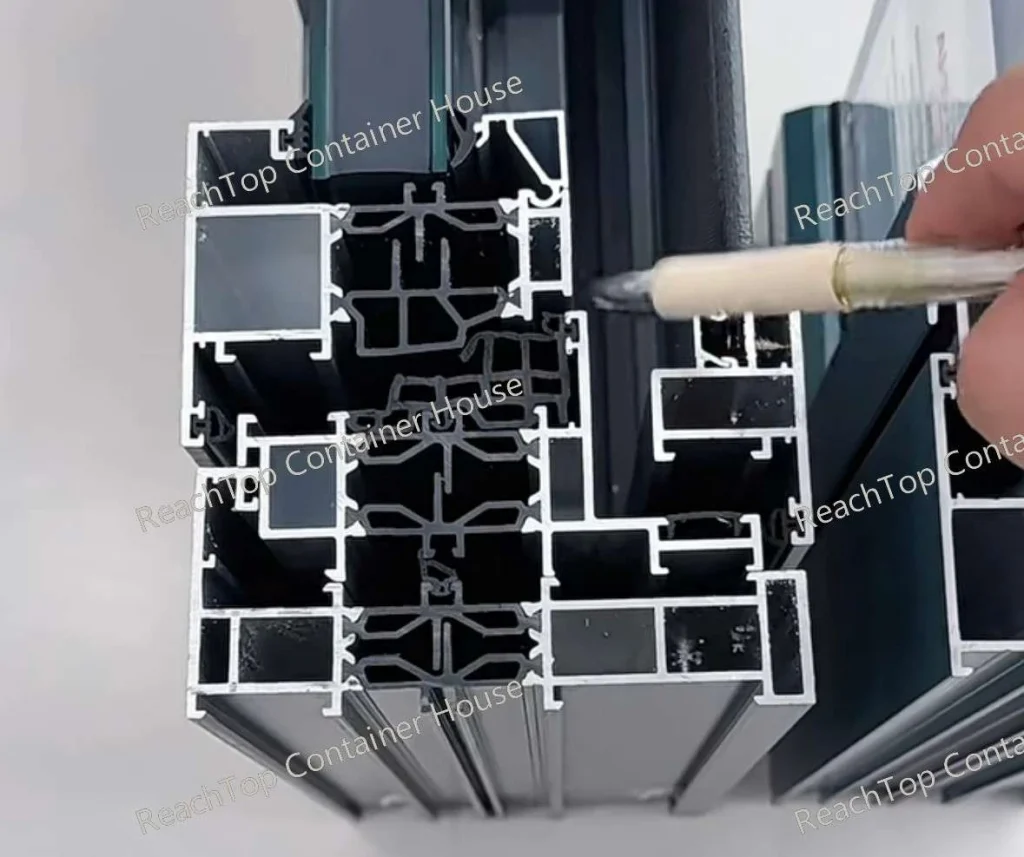
How to Check the Windows
When inspecting the windows, first confirm whether the frame uses thermal-break aluminium.
Then inspect the sealing gaskets.
Ask the manufacturer to confirm that the gaskets are made from EPDM rather than PVC.
You can also physically inspect the gasket.
An EPDM gasket should normally remain flexible and elastic. It should sit tightly against the glass and aluminium profile without visible gaps.
Be cautious if the gasket already feels:
- Hard
- Thin
- Loose
- Brittle
- Easily deformed
- Poorly fitted around the corners
Also inspect the external sealant and window drainage holes.
Pour or spray water over the window and observe whether water exits through the drainage system correctly.
Water should not remain trapped inside the lower part of the window frame.
Ask for a Water Test
Before shipment, ask the manufacturer to perform a complete water test.
The test should not only spray water vertically onto the roof.
Water should also be sprayed toward:
- Roof folding joints
- Window corners
- Window frames
- Wall panel joints
- Door frames
- Wall-to-floor connections
Wind-driven rain often enters from the side, not only from above.
For the bathroom, the drainage and shower area should also be tested separately.
Ask the supplier to record the test, including both the outside spraying process and the inside inspection.
A short video showing water being sprayed onto the roof is not enough.
The supplier should also show:
- The internal ceiling
- Wall corners
- Window edges
- Floor edges
- Bathroom floor
- Areas around pipe penetrations
These areas should be checked immediately after the test and again after some time has passed.
Some leakage problems do not become visible immediately.
Pre-Purchase Waterproofing Checklist
Before ordering an expandable container house, confirm the following points.
Roof
- Are the folding joints tightly aligned?
- What type of waterproof strip is used?
- Is butyl waterproof tape included?
- Is the roof sufficiently sloped for drainage?
- Is an additional roof available?
- Has the roof passed a complete water test?
Windows
- Are thermal-break aluminium windows available?
- Are the sealing gaskets made from EPDM?
- Is PVC avoided for the main external sealing gaskets?
- Are there drainage holes in the window frame?
- Are the drainage holes correctly positioned?
- Are the window corners properly sealed?
- Has every window been tested with water?
Bathroom
- Is there a stainless-steel tray beneath the shower area?
- Is the bathroom floor sloped toward the drain?
- Are pipe penetrations waterproofed?
- Has the drainage system been tested?
- Can leaking water enter the insulation layer?
Structure and Workmanship
- Are the wall and floor dimensions accurately matched?
- Are there oversized gaps hidden by sealant?
- Are the roof screws corrosion-resistant?
- Is the coating damaged around drilled holes?
- Are outdoor samples available for inspection?
- Are there visible water stains, rust or mould?
Can a Leaking Expandable Container House Be Repaired?
In many cases, yes.
But the correct repair method depends on the real cause of the leakage.
If the problem is a small local sealing defect, it may be repaired with:
- New sealant
- New butyl waterproof tape
- Screw replacement
- EPDM window gasket replacement
- Improved flashing
- Local waterproof treatment
If a window is leaking because PVC sealing strips have hardened, shrunk or cracked, replacing them with suitable EPDM gaskets may provide a more reliable solution than simply applying more sealant around the window.
If the leakage is caused by incorrect structural dimensions, repeated sealing may only provide a temporary solution.
The gap may reopen when the steel structure expands, contracts or moves during transportation and use.
For serious roof problems, adding an external roof is usually more reliable than repeatedly repairing the original folding joints.
Final Advice
An expandable container house does not leak simply because it is expandable.
It leaks because the structure was poorly designed, unsuitable materials were used, or the waterproofing work was completed carelessly.
Do not judge waterproofing quality only by the amount of sealant you can see.
Check the actual structure.
Check the roof joints.
Check the windows.
Confirm that the window gaskets are made from EPDM rather than PVC.
Check the bathroom.
Check old outdoor samples.
Check the screw positions.
Ask for a real water test.
And if the house will be used for many years, especially if it has a flat roof, install an additional roof.
The best waterproofing method is not allowing rainwater to reach the original roof in the first place.
* The following content was updated on July 7, 2026:
A Failed Drainage System Is More Dangerous Than Visible Leaking
A failed drainage system can be more dangerous than visible water leakage.
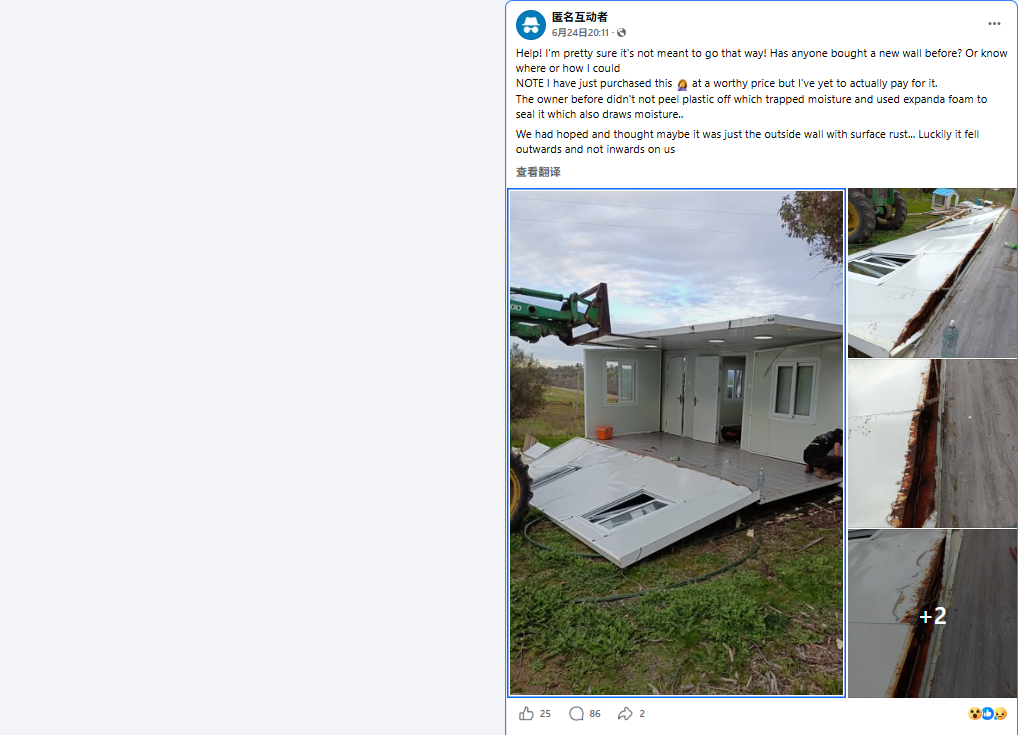
In some real cases shared in social media discussion groups, rainwater did not simply leak into an expandable container house. It flowed backward into the folding joints and hinge areas. Over time, the hinges that were not fully welded became badly corroded, and the wall section eventually failed.
If a house is leaking, you will usually notice it during the next rain. But drainage failure is different. It may take six months, one year, or even two years before the problem becomes obvious. By the time you find it, the internal steel structure, hinges, side beams, flooring, and insulation may already be damaged.
The failure path is easy to understand:
Rainwater enters the folding joint, hinge area, or roof edge → the water is not properly drained away → it becomes trapped inside panels, side beams, flooring edges, foam insulation, and sealant gaps → long-term moisture leads to rust, mold, odor, and structural damage.
The only real solution is to design a correct path for water to leave the structure from the beginning.
Once you start to smell rust, damp panels, aged sealant, low-quality adhesive, or moisture-damaged materials, we usually do not recommend relying on simple repair work anymore. At that stage, it may be better to think about how to remove the failed unit rather than how to keep repairing it. This is not an insult. It is a safety judgment.
Frequently Asked Questions
1. Do all expandable container houses eventually leak?
No. A properly designed, manufactured and installed expandable container house should not experience regular leakage.
However, folding joints, windows and wet areas require more careful design and quality control than ordinary fixed structures.
2. Can waterproof tape completely prevent leakage?
No.
Waterproof tape is useful, but it cannot correct inaccurate structural dimensions, oversized gaps or poor installation.
It should be one part of the waterproofing system, not the entire system.
3. Are thermal-break aluminium windows always waterproof?
No.
Window performance depends on the aluminium profile, sealing gasket material, drainage system, external sealant and installation quality.
For the window gaskets, EPDM is preferable for long-term outdoor use.
PVC sealing strips can age, harden, shrink and lose elasticity, which increases the risk of water leakage.
4. What is EPDM?
EPDM stands for ethylene propylene diene monomer.
It is a synthetic rubber commonly used for outdoor sealing applications because it provides good resistance to sunlight, rain, temperature changes and long-term weather exposure.
5. Why are PVC window gaskets not recommended?
PVC sealing strips are more likely to become hard, shrink or crack after prolonged exposure to heat, cold and sunlight.
Once the gasket loses elasticity, it may no longer seal tightly against the glass or aluminium frame, allowing rainwater to enter.
6. Is an additional roof necessary?
For long-term use, an additional roof is strongly recommended.
For a flat-roof expandable container house with an internal height of approximately 2.4 metres, we consider it a required configuration rather than an optional upgrade.
7. How can I inspect waterproofing before shipment?
Ask the supplier to perform and record a complete water test covering the roof joints, windows, doors, wall connections and bathroom.
The supplier should show both the external spraying process and the internal inspection afterwards.
8. What is an easy warning sign when visiting a factory?
Inspect the outdoor samples and look for rust around screw positions, water stains around windows, mould, swollen flooring and damaged sealant.
These signs can reveal problems that may not be visible on a newly completed showroom sample.
20ft Expandable Container House
40ft Expandable Container House
20ft Expandable Container House Price
40ft Expandable Container House Price
Flat Roof Expandable House
Standard Container House Price List
The Hidden Cost of Cheap Container Houses
Projects
Why Do Some Expandable Container Houses Leak?
Does an Expandable Container House Need an Additional Roof?
Is an Expandable Container House Really Ready to Live In After Delivery?